News For Adults
Plug plug
For the lefty loved-one in your life, three books of my political poetry you can get from Bookmarks Bookshop online store:
Selected Poems, Fighters for Life
Listening to a Pogrom on the Radio
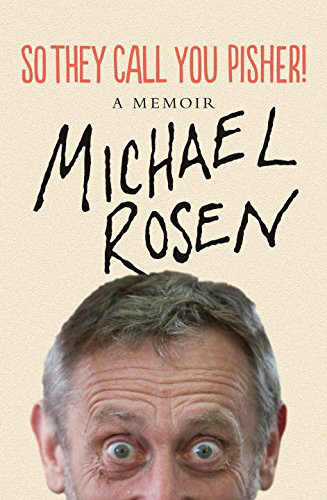
My memoir (first 23 years of my life) is So They Call You Pisher! published by Verso. It’s a reminiscence of what it was like growing up in the London suburbs in the 40s, 50s and 60s, with parents who came from London’s East End, with roots in Poland. They were Communists up until 1957 and then left, after we came back from East Germany. All this leads me to explore their background and find out what happened to the relatives who disappeared during the Second World War. But the main focus of the book is on what kind of education I got in school – and out – and what that tells me about what schools and education is for!
Previous News
Videos From Listening to a Pogrom on the Radio
Here are two new videos of me performing poems taken from my latest book, Listening to a Pogrom on the Radio, published by Smokestack Books. Both videos were directed and produced by Joe Rosen.
Two New Videos
Here are two new videos made by Joe Rosen.
The first is of me performing Hands, a poem about some of the things that my parents said that I can cherish and remember.
The next is a poem called Safe as Houses… I don’t feel separate from today’s migrants, no matter how people might perceive me.
Videos for the NHS
Here are two new videos for the NHS – one about all the people who work for the NHS and the other a parody of the kinds of things Jeremy Hunt has been saying . . .
Don’t Mention The Children Videos
Here are four more poems from my collection for adults, Don’t Mention the Children, published by Smokestack Books. They were shot by Dan Clapton at a live gig at The Wanstead Tap and edited by Joseph Steele Rosen. To see all the videos, go here…
A Great Big Cuddle
Here are two more videos of me performing poems from my book, ‘A Great Big Cuddle’, with pictures by Chris Riddell, published by Walker Books.
To see all the videos in the series, visit the following page: A Great Big Cuddle.
All the videos were directed by Joe Rosen. Go behind the scenes and see how they were made.
Uncle Gobb and the Dread Shed
I’ve written a book called ‘Uncle Gobb and the Dread Shed’ and it’s illustrated by Neal Layton. If you like funny books, this could be a book you’ll really enjoy. You can find out more at: www.bloomsbury.com/
I’ve also made some videos telling you all about it:

Social Media Update
Hello again.
One of the interesting things about the age of the internet is that it evolves. I have discovered that the best way for me to pass on latest news to adults is via facebook, twitter and a blog. So, if you’re interested you can find me in these three places chatting away most days. Please note again: ‘for adults’!
Chocolate Cake
Quite a few people recently have asked me where they can find the words of ‘Chocolate Cake’. As you probably know there is a video of me performing ‘Chocolate Cake’ right here, along with 91 other poems filmed by my son Joe plus some other videos of me in performance from BBC Learning in Scotland and the like.
The words of ‘Chocolate Cake’ are in my book of poems: ‘Quick Let’s Get Out of Here’. It’s in print and published by Puffin Books.

In Print List
As a reminder, my books of my own poems in print are:
(for younger readers)
Mustard,Custard, Grumble Belly and Gravy (Bloomsbury)
Something’s Drastic (HarperCollins Education)
Even My Ears are Smiling (Bloomsbury)
Bananas in my Ears (Walker)
Michael Rosen’s Book of Nonsense (Hodder)
Even More Nonsense (Hodder)
No Breathing in Class (Puffin)
(for older readers)
Quick Let’s Get Out of Here (Puffin)
You Wait Till I’m Older Than You (Puffin)
Centrally Heated Knickers (Puffin) (these are poems that have link to ideas of science)
Michael Rosen’s Big Book of Bad Things
(for adults)
Fighters for Life (Bookmarks)
Selected Poems (Penguin) (this incorporates 3 earlier books I wrote: ‘Carrying the Elephant’ ‘This is not my Nose’ and ‘In the Colonie’)
(videos)
WARNING: YouTube is a ‘free-for-all’ site. Quite a few people have fun taking my videos and making new versions of them, known as ‘poops’ or ‘YTPs’ Many of these are not suitable for young children. I am not responsible for either the words or pictures of these. If you want to be sure that you’re looking at videos that I made, please only go through this site. Or, if you look closely on YouTube you’ll see the tag ‘artificedesign’ . Click on that and you’ll see a ‘room’ of all 92 videos that I filmed specially for this site.
The Hypnotiser (out of print) – nearly all the poems from this book are here as videos on this site.
Michael Rosen Live – a video of me in performance in a theatre available from jan@speakingofbooks.co.uk
(audio)
There are several audio versions of my work:
Mustard, Custard, Grumble Belly and Gravy (Bloomsbury) includes a CD of the book
Even My Ears are Smiling (Bloomsbury) includes a CD of the book.
A firm called Abbey Media put out audio versions (performed by me) of:
Quick Let’s Get Out of Here
Hairy Tales and Nursery Crimes
Sonsense Nongs (me singing silly songs accompanied by Peter Gosling who once played ‘Captain Keyboards’ on TV – great fun for car journeys!)
I am reading quite a few poems at the Poetry Archive.
Announcement
I’m starting a blogspot. My long term aim is to put my articles from newspapers and journals, along with my thoughts and ideas on the blogspot and make this website more school – and child – friendly.
Here’s the URL for the blogspot: http://michaelrosenblog.blogspot.com/
News For December 2011
Before 2011 comes to an end, here’s some news of what I’ve been doing and what’s coming up.
1/. I’ve been working with the Homemade Orchestra (Tim Whitehead, Colin Riley and Liam Noble) on a jazz, poetry, film and science collaboration based on my book ‘Centrally Heated Knickers’. We’re workshopping it at the moment.

2/. I’m working at the Oxford Story Museum as a Curator, researching stories so that the Museum can have a store of stories to draw on, a group of stories to show in the museum and some ‘talk’ around stories so that the Museum has got ideas about how best to present stories to the public. The Museum will open in 2014. www.storymuseum.org.uk/
3/. The MA in Children’s Literature and/or Children’s Literature and Writing at Birkbeck, University of London is coming along great. We are on our second year now so in all there are nearly 30 students going through.
4/. My two most recent books are books of poems: ‘Even My Ears Are Smiling’ illustrated by Babette Cole published by Bloomsbury and a reprint of my ‘Scrapbooks’ under the title now of ‘Bananas in my Ears’ illustrated by Quentin Blake published by Walker.

5/. Books coming out this year are ‘Bob the Bursting Bear’ illustrated by Tony Ross, published by Andersen Press.
I have a chapter in this book, ‘Stop What You’re Doing and Read This!’
And I think (not sure!) that a book I’ve done called ‘Happy Harry’s Cafe’ illustrated by Richard Holland is coming out later in 2012 published by Walker in the UK and Candlewick in the US.
6/. The National Union of Teachers has a campaign going on ‘Reading for Pleasure’ which includes its website, a booklet, and a rolling conference season. Alan Gibbons, author and organiser of the Campaign for the Book is behind most of this and I’m delighted to be part of it.
7/. Please also see the Reading Revolution site where there is a 20-point plan for you to use and adapt if you want to make your school a book-loving school: www.readingrevolution.co.uk/

8/. I hope to be supporting Translation Nation, a great project where children tell stories in whatever language they speak (assuming it’s not English) and then translate them together into English.
9/. Please don’t forget the Perform-a-Poem website that I helped set up with the London Grid for Learning: performapoem.lgfl.org.uk/
10/. I’m carrying on with teachers’ poetry workshops at the Centre for Literacy in Primary Education.
11/. Finally a word about synthetic phonics and what’s happening in schools in relation to reading. Just to be very clear, so that I’m not misquoted or misunderstood on this: what I say and will go on saying is that synthetic phonics (SP) is one system for teaching children to read. It may well be a necessary part of teaching to read but it is not ‘sufficient’. That’s to say, it’s not enough. Recently, I have been in arguments with people about two things: a) the SP packs that schools use include a category of words which they call ‘tricky words’. These are NOT taught by SP. They are taught by ‘look and say’. That’s to say, the children are asked to just learn these words as ‘in toto’, as whole words; b) there are some schools which teach initial reading using SP and consider that the work they do with poems, rhyming words, stories, library use is not ‘teaching to read’. What I and people like me think is that this is also ‘teaching to read’. Why? Because the written language as a whole – its sound, its structure, its rhythms, its particular use of words and phrases all have to be learnt so that one can read with confidence, fluency and understanding – as well as giving motivation to learners to want to read.
12/. This month’s poetry hint for your classroom: why not get rid of your ‘Word Wall’ or ‘Wow Words’? In its place get the children to collect words, phrases, sounds, lines from poems, songs and plays that catch their attention? So just as we ask children to be curious about the environment around them, so let’s ask them to be curious about the language they hear and read. Anything that they spot, they can bring in and pin up on a space in the classroom. This then is a resource for children and teachers to use as starting points for writing poems and stories. This is what poets and writers of stories do. We collect this sort of thing and gives us language and ideas to think about to get writing and as we write. Use the words and phrases that teachers and children collect as ‘first lines’ or as ‘titles’ to see where it leads you.
13/. This month’s hint for writing stories. Scrap those ‘structure’ schemes as starting points. They are only useful after not before you start writing. To start writing you need something ‘itchy’ that needs to be ‘scratched’…a problem, a dilemma, a conflict, a lack of something or somebody and the story will be how this problem is solved or resolved or satisfied. That’s where ideas about structure come in. Not before you’ve found the problem.
14/. If you want to play the structure game, then do it with a story that is already in existence. It will always be a richer and more exciting place to start than boring structures. So, for example, if say, the children have read a story like ‘Matilda’ (Roald Dahl), get them to think about how this is structured around places – home,school etc; who is the central character – one girl; what her problem or problems are: horrible parents, horrible teacher; who’s going to help her – Miss Honey. Then say, what if you changed all those characters into animals, or people in Victorian times…and you can change the girl into a boy, the parents into a single parent, the school into a workhouse…and so on. Or again, what if it was all set in the future? Use one story as the springboard for another by changing things.
15/. Please use this link for ideas for all sorts of activities, like how to create a poetry-friendly classroom.
New Series of Free Videos
I have just released a new series of videos titled ‘Poems And Stories About My Family’. The poems are all taken from my books and this series of performances was produced by my son Joe. You can watch them now here!
Warning For Parents and Teachers
Please please please play or download my videos from this site only. These are the only videos officially sanctioned by me as being suitable for children. If you go to YouTube to download or play videos, I can take no responsibility for the material you or the children in your care watch. Please be warned: just because my face and/or voice is on a YouTube page, it does not follow that it has anything to do with me.
YouTube is an ‘open’ site, which means that the videos belong to anyone and everyone. Anyone can take them and do what they want with them.
Please take note of this.
Some thoughts
We’ve reached a massively important moment in education and this cannot be underestimated. With the Academies and ‘Free’ schools programme, the government is going to dismantle what remains of comprehensive education from 5-16.
The idea behind this comprehensive system arose out of the inequalities and unfairness in what had been on offer from 1944. That was the education system I was brought up in and it embedded unfairness into its methods at the age of 11. This was the point at which we were tested with an Intelligence Test, an English test and two kinds of Maths tests, ‘practical’ and ‘mental’. The aggregate of these scores was the main deciding factor on whether you went to a ‘Grammar School’ , a ‘Secondary Modern’ (or a ‘sec mod’) or a Technical School. Those that passed went to a Grammar, those that failed went to a Secondary Modern. Where the Technical Schools were built, you needed to both pass and opt for that kind of school.
This system failed not because left-wing, egalitarians wished them away. The system failed because what it did was found to be unfair to almost everyone in the following ways – and others:
- The percentage of children allowed to pass the tests varied from region to region. This variation had nothing to do with variations in their abilities. The variation was entirely due to the provision of the numbers of places available at Grammar and Technical Schools. This variation could run to hundreds of places. Whichever way you look at it, this meant a form of postcode lottery that was even more pernicious than the one which some claim distort the success rates of comprehensives today.
- There was a bias in favour of boys. The ‘pass’ schools were required to admit 50% girls, 50% boys. However, the tests pass rate was approximately 55% girls, 45% boys. In other words, 5% of girls were cheated out of their right to go to the ‘pass’ schools.
- The principle of having an exam at 11 was based on a theory that this was the moment when it was possible to use tests to predict children’s academic outcome ie what they would be capable of at 14, 16 and 18. The longer the system was in place, the less reliable the tests became. There were several reasons for this: a) some schools became very good at coaching for the tests. This meant that some children who found it hard to cope with the Grammar School system were getting into those schools. This tended to knock them back rather than enable them to succeed. They were often put in a bottom stream which usually meant that they left school with very few or no qualifications. b) some Secondary Modern schools became very good at ‘bringing on’ the pupils they identified as their most able. These pupils went about ‘proving’ that the 11plus exam had been a wrong predictor of what they were capable of. They passed exams at 16 and many went on to more education between 16 and 18 either at Grammar Schools or in the various forms of further education colleges that were emerging at this time.
- The funding of the two main branches of secondary education was found to be discriminatory. One piece of research claimed that spending per pupil in the Grammar Schools ended up being about twice that of what was spent on pupils at Secondary Modern Schools. It was also shown that the qualifications of teachers in Grammar Schools (percentage of Honours Degrees, MAs, Ph.Ds, high grades for those degrees etc) was much higher than teachers at Secondary Moderns. This didn’t prove of itself that the quality of teaching was better, but did point to a level of academic experience that the Grammar schools could draw on which the Secondary Moderns could not.
- Though much attention has been given to the fact that the Sec Mods education was in many cases poor, the level of corporal punishment was very high, the number of unqualified teachers was very high, the Grammar Schools were not without problems too. What was offered, was in many cases very narrow, the regime was based on a watered down private school system with rewards, punishments and ethos devoted to the very similar ideals. At the time, it was rarely questioned as to whether this was appropriate, useful or successful.
During this time, primary schools were of course ‘comprehensive’, and no one questioned that. Quite why children aged between 5 and 11 should be thought to benefit from local comprehensive education but those between 11 and 16 or 18 would suffer has never been clear from those who favour specialisation. Perhaps there is some kind of developmental syndrome which the theorists of selection and segregation know about but haven’t as yet told us about.
So, comprehensive secondary schools were introduced from the late 50s onwards. Let it be said straightaway, this was done in a piecemeal, uneven way. At no stage were private schools abolished. At no stage were a range of other state-funded secondary schools which enabled some parents in most areas to slot their children into selective schools. At one time these were called ‘Direct Grant’ schools, later some were known as ‘Foundation’ schools. Some have transformed themselves into Academies. Right from the start of comprehensivisation, these schools were able to withdraw from local authority control and select who they wanted and who they didn’t want. In some areas, this led to what was really a de facto Grammar School/Sec Mod system. It just so happened that there was no ‘11plus’, only an entrance exam and interview to get into this local specialised school.
Throughout the period of maximum comprehensive education, the system was under attack – and in retrospect, it is still being attacked. It’s not possible here to answer all the criticisms but I’ll try with some of them.
They were ‘bog-standard’. This is a lie. The schools were different from each other and offered very different options for the pupils.
They caused bright children to fail. There is no evidence for this. Education research has to try to do the impossible: which is compare like with like. It is virtually impossible to compare a child, or a group of children from, say, 1970 and compare that group with a group from, say, 1955, or 1995. One method is to use ‘economic indicators’ ie whether they were poor or rich. Another method is to use the tests.
There are big problems with both these. The economic indicators don’t include cultural ones. The cultural composition of children in many areas has changed. Simply identifying children by their parents’ income doesn’t tell us about how children are affected by how late into the system they came, if they spoke a language other than English, the effect of major disruption on their lives due to migration, whether mitigating effects were put in place to help such children deal with the disruption, their language situation or indeed any explicit or implicit discrimination directed towards them.
The tests have changed too and within the tests there are many examples of what is known as ‘cultural’ bias. Asking inner city children what the difference is between a spade and a shovel, or asking non-Christian children what a candle is lit for at ceremonies, would be examples of this.
Even so, one rough and ready guide to whether the comprehensive system worked is to do with qualifications. During the reign of the 11-plus, many pupils (most Sec Mod pupils and some Grammar Schoolers) left school with no qualifications at all. This marked such people for life. They were deemed to be people who ‘could not’.
Meanwhile, the comprehensive system produced plenty of high fliers. There is some evidence to show that being a high flyer in a comprehensive did you no harm at all but being someone who struggled with education, the system was better for you than if you had gone to a Sec Mod (in those areas where Sec Mods have survived).
The persistent myth about comprehensives is that were full of what Lord Adonis calls ‘the excuse culture’. This he and others claim makes excuses for failure. This is a cheap trick. The teachers and educationalists who were committed to the comprehensive system sought to find explanations for why children failed not in order to explain it away but in order to demand greater support, greater help and the chance to explore new methods of teaching and assessment. In fact the GCSE exam came out of precisely those kinds of discussion! It is an insult and a lie to suggest otherwise.
What the present government is introducing is essentially a system to break local authority control over schools. It’s very easy to present this control as pernicious because many of us can point to occasions when local authorities have behaved in high-handed and negligent ways towards our children.
I wouldn’t want to defend that. However, there is one principle that local authority control worked on: the ‘cohort principle’. That’s to say, its responsibilities were for a whole locality of children going through the system. For all its weaknesses, this is what they did. People live ‘in localities’. That’s to say, realistically, a child can only go to a range of schools within walking, bus or short train distance from their homes.
It is only right that this cohort, determined by those distance criteria are treated fairly and equally.
This is what the government has changed. It is introducing a system that asks schools to deal with their own cohort, not the locality’s as a whole. This creates a system that does not take equal responsibility for every child, for every family.
This takes into new territory. Since the early education acts in the nineteenth century, which gave responsibility to ‘school boards’ to run ‘elementary’ education, we have lived with the idea that officers chosen by our local elected representatives and in conjunction with them, ran education with equal responsibility for all children.
To repeat, this is no longer the case.
To play at prophet for the moment, I predict that this will produce a great divergence in the quality of schools – which has often been the case of course. But this time, the ability to alter this quickly and fairly will be extremely difficult as it is only central government that has control over schools not doing well. There are limits to what central government can do across a whole country.
Within that there will be the problem of how children are chosen, not chosen and excluded from the various kinds of schools. Again to play at prophet, it rather looks as if we’re moving into a system where ordinary schools (ie those ones available for anyone to go to) will in fact be schools that can either not choose or exclude all kinds of children who are deemed to be not appropriate for that particular kind of school. I suspect that this will produce a whole structure of ‘sub-schools’ , ‘units’, ‘sin-bins’ , ‘special schools’ where anyone marked out as ‘disabled’, ‘special needs’ , ‘behavioural difficulty’, ‘persistent truant’ etc etc can be put.
The comprehensive system asked for special help for all these kinds of young people. It asked for help ‘on-site’ so that such children might benefit from contact with everyone and, just as importantly, everyone could benefit from contact with them. We are one human race and we have to solve problems for all of us and none of us knows when we or our dependents might need that kind of help. Better it be something we all deal with, rather than something we tuck away in special units.
There is no evidence that these special schools will get the same funding, the same quality of education, the same level of support that the new, part privately funded schools will get. Quite the opposite. I suspect that these will turn into a whole class of sub-school or sump school which the new system will pass back to the local authority. Local authorities are under massive pressure to trim and cut – why will they try to match the funding that the new schools attract? Once you’ve segregated children off as disabled, ‘special’ and, in a variety of ways, ‘delinquent’ (to use and old-fashioned term), it becomes that much easier to suggest that such people are difficult or less deserving.
These, I think, are some of the challenges facing us.
Birkbeck College, University of London
Notice to teachers, librarians, editors, writers – or anyone with a keen interest in children’s literature.
We are now recruiting for the MA in Children’s Literature and the MA in Children’s Literature and Writing, that I co-designed with the Birkbeck team. This is for starting in October 2011.
If you have any queries, do feel free to get in touch at m.rosen@bbk.ac.uk and I will be happy to try to answer.
About Libraries
Here is a ‘post’ I put up on a Guardian blog about libraries:
Books have become optional extras in schools. They’ve been sidelined by ITC and worksheets. There is now a generation of young teachers who have been through teacher training with no more than a few minutes of training in children’s literature and little or no work on why it’s important for all children to read widely and often and for pleasure.
So, what we have is the notion that there isn’t time to read whole books, there isn’t time to help all children browse and read and keep reading – but there is time to do worksheets on different aspects of ‘literacy’. And yet, the people running education know full well that children who read widely and often and for pleasure find it much easier to grasp the curriculum as a whole. There is an international study showing this.
What does this have to do with libraries? If the government (or the last one) had felt willing, all they needed to do was formalise the link between schools and libraries.
They could have required every school and every library to lay down some fixed, timetabled sharing of time and resources, which would involve turning the present voluntary arrangements into certain ones. In one fell swoop it would guarantee library-use and massively enhance the children’s progress.
I put all this in a document in Margaret Hodge’s library review where it was immediately ignored. I sent it to Ed Vaizey (because he asked me to), and he too has promptly ignored it.
Ed Balls and Vernon Coaker both refused to ask schools to develop their own policies on the provision and reading of books. Neither Ofsted nor schools’ ‘Self Assessment forms’ require schools to make the provision and reading of whole books something that they monitor.
In short, education and library ministers aren’t really very interested in the idea of everyone reading whole books, and they’re certainly not very interested in the idea of every child reading whole books. I even gave them a 20-point blueprint or outline on how to turn every school into what I called a ‘book-loving school’ (based largely on the TV programme I did ‘Just Read’. And that’ blueprint is now available on various websites. The ministers I met weren’t interested in sending it out, either as it is, or in any adapted form.
It’s clear that they think ‘reading’ is about ‘doing literacy’ ie learning how to ‘decode’ print. What they don’t seem to understand is that literature is one of the main ways in which we can engage with difficult and important ideas in an accessible way. It offers children a ladder between their own personal experience, the apparently ‘personal’ experience of the protagonists in any given text, and the ideas that are thrown up during the adventures, scenes and feelings that the protagonists go through. So, the reader encounters the protagonists’ feelings of, say, pity, anger, fear, guilt, envy and the like but in a school context (or indeed many social contexts) those feelings become talk about those feelings as ideas…eg what is ‘pity’? what is ‘guilt’? ie through reading, the young reader starts to generalise the particular or put another way, discover abstract thought.
Children who read widely, often and for pleasure are the ones who can make the transition between particular experience to abstract thought that all education asks of children between the ages of 8 and 13. The more you read, the easier that transition is. The kids who fall behind don’t fall behind because they haven’t done enough worksheets. It’s because the education curricula haven’t helped them discover a wide range of texts through being regular readers.
December Bits
Here’s a write-up of an important new booklet on initial reading, which seeks to counteract the government line on the exclusive use of synthetic phonics.
Here I am meeting the American Childen’s Laureate, Katherine Patterson. She had just delivered a brilliant, thoughtful and funny speech about her role and about books for children.

Here is my Guardian review of Daniel Pennac’s book ‘School Blues’.

November Roundup
A Guardian blog thread about Michael Gove, that I contributed to.
Article about Ted Hughes’s ‘last’ poem for the New Statesman magazine.
Wandsworth teachers at a workshop with me on hooking up with Perform-a-poem.
Poetry Right Now
A series of poetry workshops for teachers is running at CLPE again next year. Teachers work along side Michael Rosen Children’s Laureate to develop their confidence in teaching, as well as their personal understanding and enjoyment of poetry.
Lambeth CLC
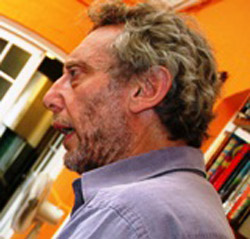
Here’s me doing a poetry workshop in Lambeth, London:

Over 30 Lambeth teachers had an inspiring day at the CLC on 17 September working with Michael Rosen to explore “How to make our classrooms places where poetry can live.” Michael moved seamlessly from stimulating a group poem about squashed peas to discussions about Vygotsky, feelings and images, poetry detectives, ellipsis, secret strings and poetry shows. Teachers then performed and recorded poems learning about camera shots, audio, editing and uploading to the LGFL Perform a Poem site. Loads of learning and great ideas to take back to class.
Dickens Conference
Here’s an ad for a Dickens conference that I’m taking part in:
Hard Expectations or Great Times: Making sense out of Dickens
British Library in partnership with The Charles Dickens Museum and The English Association
British Library Conference Centre
22 November 2010
9.30 – 17:00
Do your students find it a challenge to engage with Dickens’ work? Are you interested in finding out about new ways to engage with his novels?
Actress Miriam Margolyes and poet Michael Rosen are two of the experts from the worlds of theatre, film and academia who will be sharing their knowledge and experience of Dickens at this conference.
In partnership with the Charles Dickens Museum and the English Association, this British Library teachers’ conference aims to deliver a programme that immerses teachers in 19th century English Literature and attempts to help secondary school teachers overcome some of the challenges faced when teaching Dickens. Discussions will question a variety of ways to interpret Dickens’ work, while workshops will explore innovative techniques that can be taken back to the classroom. Sessions will include Dickens and Film, Teaching Great Expectations, Dickens Journal Online and British Library workshops on English Language and Literature.
There will be a drinks reception at The Charles Dickens Museum following the day’s programme.
Tickets are £45. To find out more and to book please visit the English Association website.
Guardian Books
Here’s a Comment by me on Guardian Books blog re Early reading and synthetic phonics
MichaelRosen – 1 October 2010 12:22AM
“Don’t confuse learning to read with learning to enjoy books.” said someone above. In fact it’s a brilliant idea to confuse learning to read with learning to enjoy books, because children who enjoy books will want to learn to read, go on reading, will understand books, will love books, will do unbelievably well at school. The government knows this. They have national and international stats to prove it, but they have refused on several occasions to do anything about it. They refused to send out a simple request (not a demand or a directive) to schools to ask them to form what I called ‘books policies’ ie a policy on how the school would provide and use books.
Much more politically expedient is to talk again and again about synthetic phonics. We should remember several things about SP: 1. SP will never teach every child everything there is to know about reading. That’s because when we write, we don’t write phonically all the time. This is acknowledged by the SP systems that all schools are now using with their description of many words as ‘Camera Words’ (as someone pointed out earlier on this thread) or ‘Tricky Words’. What is going on here? The SP people are agreeing that some words can only really be learned through another system altogether known as ‘look and say’ or ‘look and read’, involving whole word recognition and recall. What the SP people won’t acknowledge is that many children will also be learning to read some, or many ‘phonic words’ through whole word recognition and recall, or indeed through other mechanisms.
2) the other problem with SP is that it separates sound from meaning; separates words from meaning. This runs against the stream of why we talk, listen, read and write. We do these things in order to exchange meanings. For some children this won’t matter, particularly those children who come from highly literate homes who have already learnt that ‘words’ can in some way be separated from the things and ideas and processes they refer to….eg through people saying, look there’s a word, or look how that’s written, or indeed encouraging their children to play with words orally and in writing…
What we don’t know is whether the kinds of children for whom learning to read is really difficult are going to find this link between words and meaning really hard as a result of pure SP teaching.
However, we do know some things from the small piece of research that the governments (both) think is the killer blow in the argument for universal SP teaching in every state school. That is that far from resulting in a dramatic improvement in reading in children five years after SP – it caused a very small increase and by then, that increase could have come from any other number of causes going on in that school in that particular time – especially as things that should have been kept constant, were not (eg intervention of home-school liaison reading officers, and the introduction of philosophy teaching in the school). And there’s more. The comprehension scores went down. What?! So the children were reading marginally better than the norm, (for reasons we don’t know) but they were less able to understand what they were reading! And this is the system that every school in the country is spending thousands of pounds on.
Now, you won’t get politicians saying any of this, either because it’s too hard for them to understand the problem or because it isn’t politically expedient. Phonics is a political matter. It sounds ‘ard. It sounds tough. It sounds as if you’re getting the little blighters to knuckle down and get it. When you see it being taught, it looks instructional, and active. Everyone’s doing the same thing at the same time. It looks as if everyone is progressing. That’s why politicians like it. It fits the agenda of what people want to be saying about the relationship between children and adults in the present time.
In the meantime, it’s wonderful to think that for the moment we live in a country that has free books. This was won for us by our forbears. You can get out 12 books on one library ticket and the next day, take them back and get 12 more. If this government gets its way, this will be taken away from us. For parents who have the money and are interested (not necessarily always linked), there will be books in the house. For those who can’t afford books, all their children will have is SP and whatever that school happens to provide. If it’s a school who is crazed with nervousness about SATs results it will have filled the school with worksheets and testpapers and spent next to nothing on books that the children would normally choose to read – funny, naughty, odd books.
Believe me, we are facing some tough times ahead on this matter.”
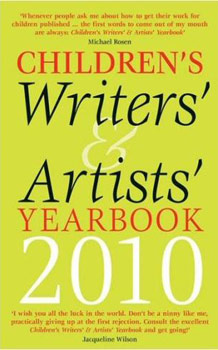
Here’s my introduction to this year’s Writers and Artists Yearbook
People who can write for children don’t come with a same-format personality or a made-to-measure range of skills. We aren’t people who can be easily categorised or lumped together. In part, this is because the world of children’s books is constantly changing, starting out from a very diverse base in the first place. This derives from the fact that the world the children inhabit is changing and indeed that there is a recognition within the children’s books milieu that books are for everyone, not just one small section of the population.
In a way, this means that this is a great time to be writing or illustrating children’s books. But that comes with a warning: diverse and changing – yes – but within a set of conventions (I won’t say ‘rules’), and formats. So, quite often I hear of people who say that they have written some stories or poems for children and would I please take a look at them. Sometimes, the first problem that I can see with what they’ve written is that it doesn’t ‘fit in’. Or, another way of putting it, the writer hasn’t taken a look at what’s out there in the bookshops and schools and thought: how can I write something that could go alongside that book, or fit the same niche that that particular book occupies?
But what about artistic freedom? What about the rights of the writer to write about anything?
Two things in response to that: nothing can stop us writing about anything you want to, however you want to. But there’s no point in kidding ourselves that writing is really ‘free’. We all write with our ‘reading heads’ on. That’s to say, we write with the words, sentences, pages, chapters, plots, characters, scenes of the books we’ve read. If you say to yourself, ‘I want to write a novel’ or ‘I want to write a picture book text’, you’re only doing so because your mind is full of novels or picture book texts. They are the ‘already written’ or the ‘already read’ material we write with. This affects everything we write, right down to the shape and structure of what we write, the tone we hit in the passages we write, the kinds of dialogue and thoughts we put into the writing. A crude analogy here is cooking. We cook with the ingredients that we are given. But more: if we say, we are going to make a cake, there is an understood outcome of what that will be (the cake), and an agreed set of ingredients that can arrive at that understood outcome. So, in a way, we not only cook with appropriate and given ingredients, we also cook with an understood outcome in mind. It has a shape, a smell and a taste that we expect the moment someone says, ‘Here is a cake.’ Our memory of past cakes prepares our mind and taste for what is to come. This set of memories of past writing and reading is what is in our mind as we write and indeed in the minds of the child readers as they sit down to something they can see is a book, or a novel or a picture book. These are what are knows and the ‘intertexts’ we read and write with – memories of past texts.
Secondly, though of course you can write about anything you want to and in any way you want to, I would say that if you’re interested in being published, then you have to look very, very closely at what publishers publish. This means looking at books not only from the point of view of what they say and how they say it. It means looking at what kind of book it is, are there are other books like it? How would you categorise it? This asks you to put into your mind a sense of format, of shape, of outcome to guide you as you write. Another analogy: an architect who is asked to design a house knows that he or she has to create rooms that are high enough and large enough for people to live in, that there is a basic minimum of kitchen and bathroom, there is a door to get in and out of and so on. If it fulfils these conditions, we will call it a house – and not a factory, or a warehouse, say. It’s a great help sometimes to look at books from an architect’s point of view: what is in this book that was necessary to make it work? Ask yourself, how did the writer reveal what was coming next? Or, how did the writer hold back and conceal what was coming next? (Writing is a matter of revealing and concealing!) How did the writer arouse your interest? Was it an invitation to care about the people or creatures in the story? Or was it more to do with events or happenings? Or both? Did the book announce itself as being of a particular genre: thriller, historical fiction, comedy etc? How did it do that? What are the requirements of that genre? Or is it a hybrid?
If all this sounds too technical then I’ll introduce someone else: the child. If you say to yourself, I’m going to write for children, then even as you say this, you’re putting an imagined child (or children) into your mind. This is what literary theorists call ‘the implied reader’. We do this in several ways. There might be a very real child we know. Robert Louis Stevenson wrote ‘Treasure Island’ largely as part of his relationship with his stepson, Lloyd. But even though we might say, ‘RLS wrote it for Lloyd’, this doesn’t really explain things. What Stevenson was doing, possibly without knowing it, was keeping a mental map of Lloyd’s speech and personality in his mind, so as he wrote, he had his version of Lloyd in his head monitoring, guiding and censoring what he was writing.
There is no one way of importing the implied child reader into your head. Some writers do it from memory. They connect with the child they once were, using that version of themselves to guide them in what they write and how they write it. They use memories of what they liked to read, how they themselves spoke and thought and perhaps wrote, when they were a child. Others immerse themselves in the company of children – their own, their grandchildren, nephews and nieces or children in playgroups, nurseries or schools. And some do it by immersing themselves so thoroughly in children’s books, they pick up the implied child reader from the books themselves. And of course, it’s possible to work a combination of all of these ways. What I don’t think you can do is ignore them all.
In fact, what you write can’t avoid an implied reader. That might seem odd, because you might say that you had no one in mind when you wrote this or that poem. The reason you can’t avoid it, is because the language we use comes already loaded up with its audience. So, if I write, ‘Capitalism is in crisis’ this is a phrase that implies an audience that first of all understands English, then understands the words ‘capitalism’, ‘crisis’ and the phrase ‘in crisis’. But more than that, it’s an audience that wants to read something like that, is in a sense, hungry or prepared and sufficiently ‘read’, to want to read such a sentence – or, more importantly, to go on wanting to read what comes next. If I write, ‘My Dad was attacked by a banana…’ then I’m already positioning the reader to think about someone who is a child and that child is telling something a bit absurd or possibly funny, perhaps the beginning of a family anecdote or family saga. It’s also a ‘tease’, in that a reader who ‘gets it’, will know that bananas don’t attack anyone. It implies a reader who knows that. In other words the ‘implied reader’ is ‘inscribed’ into what we write. These implied readers are in a sense stuck to the words, phrases, sentences, plots, characters we write.
This means that as we write – and after we’ve written – it’s a good idea to go back over what we write and think about the implied reader we’ve put there. Who is the child who is going to ‘get it’ ? Who is the child who won’t? What kind of children are we talking to? What aspects of those implied children’s minds and childhoods are we talking to? The fearful person in the child? The envious one? The yearning one? The lonely one? The greedy one? And so on.
A last thought: we talk of ‘writing for children’. To tell the truth, I don’t think we do just write for children. I think we write as a way for adults to join the conversations that adults have with adults, adults have with children, children have with children – on the subject of what it means to be a child and live your life as a child. Because it’s literature, this conversation often comes in code, with ideas and feelings embodied in symbols (teddy bears, giants etc), it arouses expectations and hopes (what’s coming next?) and because it’s literature that children can and will read, it often comes along according to predictable outcomes (getting ‘home’, getting redeemed, being ‘saved’, removing the obstacles to unhappiness and imperfection that the story began with, and so on). Nevertheless, children’s literature has a magnificent history of saying important things to many people often in a context in which adults are caring for children. I think that’s a good thing to attempt.
Some thoughts from workshops this month
1. We shouldn’t be talking about ‘Literacy’ as if there is just one ‘literacy’ and it’s our job to teach this single thing. In fact, everyone has a literacy. From the moment each one of us is born, we are bombarded with literacy – to start off with it’s present in the things that people are saying and singing to us, quoting things that have been written – even if it’s a lullaby. So, really we should be talking about ‘Literacies’.
I think that when we teach ‘Literacy’, then, one of our jobs is not just to ‘teach’ it in the orthodox sense, but to release the children’s literacies. Let’s find out what they are literate in and find ways of getting it out, sharing it, publishing it, filming it or whatever.
2. The government only records children’s and schools results in ‘Reading and Writing’. This pressures schools and children to focus on these two aspects of language. In fact, language is about speaking, listening, reading and writing and for the best outcome, we need to spend time nurturing and encouraging all four. If we focus on just one or two aspects, things start to go wrong and we produce impoverished reduced versions of what children are in fact capable of. I can see that in years 5 and 6 in particular, children are getting starved of speaking and listening.
It would be much more productive to think of these four processes as linked and that there is or should be a constant flow between all four of them. The biggest obstacle for children in relation to writing is making the leap from the oral to the written. We should be looking constantly for bridges. The most potent, accessible and user-friendly bridge is poetry.
3. Poetry can express what we say, it can express our ‘inner speech’ – the conversations and monologues that go on inside us.
Poetry doesn’t have to come to neat conclusions – it can suggest, it can end on questions.
Poetry is a great ‘scavenger’ of language, it can go anywhere, grab anything, imitate anything, parody anything, adapt and change anything. It vacuums up speech, writing and performance from anywhere and everywhere. This gives power to children, because instead of seeing language as fixed, received and rule bound, they can see it as something that they can own, it’s malleable, they can play with it, and they can establish their own rules for what they’re writing or performing.
Poetry is a great carrier of culture. If we think of culture as the ‘how’ of our lives – how we speak, how we cook, how we dress, how we make families and so on, poetry is a great way to record and witness these things. This means that in schools if we do poetry, it gives children a chance to have their culture noticed, appreciated and validated. This makes it a great weapon in the battle against what I call the ‘I’m not good enough’ syndrome.
Poetry is a way of putting things about yourself in front of you, as a form of display. It enables you to free your thoughts and emotions from the endless, unresolved cycle in your head. It gives you some distance from yourself, when you look at what you’ve written, sitting on the page in front of you.
4. If school is about investigating, discovering, inventing and co-operating (something that I believe), then poetry is a great medium for these. However, this means that the reading of poems needs to be open-ended, full of questions that come from everybody, not just the teacher.
Questions like:
does this poem remind you of anything that’s ever happened to you or someone you know? How come? ;
does this poem remind you of anything you’ve ever read before, or movie or TV programme you’ve seen before? How come?
If you could ask someone in the poem a question, what question? If you could ask some thing or object in the poem a question, what question?
If you could ask the author or publisher of the poem a question, what question?
Can we answer these questions?
If we think of the sounds, words, phrases, images, meanings of the poem stuck together with ‘secret strings’, what secret strings can you find that link sounds, words, phrases, images and meanings in the poem? What patterns can you find?
Perform-A-Poem
For teachers in London, please take a look at the Perform-a-poem web-pages on the London Grid for Learning site. This is where you can upload your pupils’ poetry performances in an ‘esafe’ environment. Take a look here.

The Scottish Universities’ International Summer School
I’m doing a class on children’s writing at the Edinburgh University International Summer School this year. See August 18 here.
Education for Liberation
There was a conference called ‘Education for Liberation’:
Education for Liberation
I think our job as liberationists, socialists, humanists, Marxists is to examine closely, the content, the methods and structures of education to see what are the philosophies that underpin them, how the different parts function, what are the consequences?
This enables us to posit alternatives.
What are the means by which education in the present context is against liberation?
One of the difficulties we have with thinking about education is that we are easily led into thinking that the process of being at school is simply or only a matter of being taught. In fact, schooling is about many things. So, though it is true that teachers are asked to teach certain ideas, concepts, skills and certain kinds of knowledge, and that we should look at these, we should also be much more holistic than that, and look at the all the processes of schooling.
So, first, can we break down these processes into several categories before putting them back together again into a whole?
There is 1) the curriculum – which is quite well documented in the papers, and booklets. However, these do not and cannot state exactly what gets taught in lessons. In other words, there is an ideal curriculum and an actual one.
There is 2) how the curriculum is taught. This is the process by which teachers teach. This is not simply described because teachers teach in a variety of ways: whole class lectures, with or without previously issued notes, whole class discussion chaired by the teacher, group discussion supervised by the teacher, writing solo, writing in pairs, writing in groups, writing initiated from worksheets, writing initiated from whole class stimulus, practical investigations with specific parameters set by the teacher, team teaching, pupils setting up the subject of study through raising questions, pupils examining a given subject by setting the questions and so on. Each of these methods has embedded within it a social and political philosophy that is part of schooling.
There is 3) how power is sustained. In any school, there is a power structure. At one level, it’s easy to see what that is: a head teacher, senior staff, post-holders down to classroom teachers, then on down to teaching assistants and non-teaching staff, and finally to the pupils themselves who may well be arranged hierarchically according to age and some kind of responsibility as with ‘monitor’, ‘prefect’ or ‘house-captain’ systems. What is not so easy to see is how these power-structures are sustained. Is it only or purely through some kind of punishment system – detentions, ‘on report’, suspensions and the threat of expulsion? Or are there other systems eg behaviour-reward systems which also serve as minor punishments for all those who don’t ‘win’ the rewards as with ‘smiley faces’ and ‘stars’ in primary schools and the apparatus of ‘certificates’ throughout the school system. There is also the question of the testing/exam systems which are outwardly about the curriculum but are also about sustaining the power structure.
There is 4) how schools are organised in relation to each other. In every area and across the country there is a hierarchy of schools. So nationally it’s understood that Eton, Harrow and Winchester are ‘top’ schools and, then working down through the private schools, through the ‘top’ state schools, we arrive at what are supposed to be the worst schools. We can ask: who arranges this hierarchy and how do they do it?
Now, let’s put all four processes together and ask some questions about who is involved in laying down the structures and processes? It’s clear straightaway that children and students are excluded from controlling any of these. They have no part to play in any of them. So straightaway we’re confronted with a piece of naked power politics: the people on the receiving end of schooling have no say in what happens to them, the moment they cross the threshold of the school. This is quite extraordinary and exposes the hypocrisy that lies behind the word ‘education’ in our society. Remember, the claims made for education are that it teaches children ideas that will equip them to play a part in society and that our society is one based on tolerance, freedom and democracy!
However, it is not only pupils who are excluded from the processes. To a large extent classroom teachers are excluded too. .
So: we can say that the curriculum (more so in the last decade than ever before) is laid down by the government and its agencies, passed down through documents and dictated through teachers to the children. This process if policed by the use of testing, exams and inspection – none of which incorporates any voice from pupils or classroom teachers. In other words, it is an utterly totalitarian process.
How the curriculum is taught is to a very large extent (but to be fair, not entirely) controlled by the same system: government and its agencies. In rare circumstances, where the senior management of a school is courageous then the processes of teaching have been liberalised to include a good deal of pupil discussion, pupil ownership of learning. However, this is always circumscribed by exam results and inspections and even in the most liberal of institutions it’s very rare that pupils themselves have a say in determining that very liberalism!
The power-curriculum (ie how power is sustained) is to a large degree laid down by government through inspection systems and therefore from government.
How schools are organised in relation to each other – there is a long history of selection, specialisation, privatisation, academies, league tables, clusters, eaz’s, beacon schools – all of which is now very closely controlled by central government. Neither teachers or pupils are involved in any of this.
Following from this, if schooling is now largely controlled by central government, then are adults (as voters) involved in making these decisions? Only to a very minor degree. Consider the bringing in of academies. This has happened with no real political debate, no real mandate. Where localities have opposed the arrival of academies, they have been over-ruled.
Just as significant, is the rather extraordinary idea that education should be something that takes place in institutions determined by the age of those to be educated. Indeed, part of why education is so totalitarian is for the very reason that it’s seen as something that is done ‘to’ children, as opposed to being a process that anyone of any age could take part in. To state the obvious, schools would be very different places if they were open to all, no matter how old or young.
Some points for consideration:
We should be wary of getting drawn into arguments about what is taught. This is to argue on the ground that the education-totalitarians like the best. Of course, we should not totally neglect this field, but at the same time, we should remember that it is quite possible to teach eg the history of slavery, in a hierarchical, dominating way. In which case, little or nothing has been achieved.
So,much more crucial are questions of control. If we are serious about ‘education for liberation’ we need to expose who controls education, we need to argue for democratic processes throughout the four areas of education.
If we don’t, we are in effect saying to pupils that these processes are fixed and inevitable. So to take one example: the smiley faces in primary schools. Children who behave well are rewarded. There is a smiley face chart and every child in the class sees the smiley face chart. The child with many smiley faces is rewarded every day by seeing his or her name next to a row of smiley faces. Everyone else sees that they are not so good as this child, some nowhere near as good as this child. This teaches the majority of children: ‘the not good enough’ principle ie ‘I am not good enough’. However, it also teaches that this structure of top dog, nearly top dog, middle and nowhere near top dog is ‘normal’. The all-powerful adult has set up something that is ‘obviously’ fair and appropriate – reward for being good – without the idea or the notion of a hierarchy of ‘good behaviour’ being up for debate or questioning. It also teaches that it should be the sole prerogative of this powerful adult to determine what constitutes ‘good’ and who is ‘good’ and by default what is ‘not good enough’ and who is ‘not good enough’. Making the judging and classing of children natural and inevitable is one of the most powerful processes of education and it’s one which we should be challenging.
If you link smiley face charts with the setting and streaming of children, which goes on in some schools from the age of five, then we can see that a majority of children are being taught from a very early age that they are not good enough. Whatever else is going on in schools, this is, I would suggest, the main agency through which class and race hierarchies are reinforced through schooling.
This should lead us into looking closely at several things eg the processes by which certain children end up being setted in the bottom sets, and failing to earn smiley faces.
One of the key theories we can look at is that of Bourdieu. He argued that schooling serves best the children of those who have already been schooled the most. He talked of a ‘habitus’ which, in relation to educated parents, means that such parents create a home background that uses a language and a mode of thinking that matches and suits the kinds of education (in all four of my categories) that goes on in schools as presently constituted.
So, schools as constituted, prioritise certain kinds of knowledge, certain ways of talking, writing and thinking; their power structures involve a certain kind of deference and acceptance and the hierarchies between the schools involve a certain notion of how society should be arranged along ‘natural’ lines of privilege and elites.
Consider kind of knowledge: why is it that some kinds of knowledge have no place in schools – or if they are there, they are very low in status until the theory of such activities is tackled higher up in education eg farming (and all food-creation), cooking, nurture and building. Yet, these are the processes by which the human race survives. The fact is there is real expertise in each of these processes held in many different ways by the least educated people in society. It can be stated that in general terms, the kind of subjects that have the most status in education are those subjects that the most educated people can control and determine. This suits very neatly the requirement that education produces a hierarchy that roughly resembles the class structure of society. This is what Bourdieu called ‘reproduction’.
This also applies to the kinds of hierarchies I’ve described which are shown to children as ‘natural’. This a) suits those who rise to the top and b) those who show the right degree of deference and acceptance that this system is indeed natural. It’s a neatly self-reinforcing system for the parent-achievers and the sons and daughters of achievers. For those parents who weren’t in on the system when they were going through it, it’s very hard (not impossible) for them to crack the code on behalf of their own children.
If we are serious about an education for liberation, we should be laying down
- alternative principles based on how teachers and students can co-operate and enable learners to take control of how they learn and what they learn
- alternative principles on how education is organised, how schools are run, and what happens to power inside schools..
- alternative principles in relation to cognition and democracy: that’s to say, an education based on investigation, discovery, discussion, imagination and play.
Just to unpack that – ‘investigation and discovery’ is not a privatised, individualised activity. They are rooted in co-operation, debate and action. In turn, action is rooted in making, doing and creating.
We should be challenging who controls education and how they control education in order to pose alternative models. These alternative models will come through the kinds of struggle we take part in as with, say, opposition to SATs. Here, parents, children and teachers take part in fighting against a government imposed system of power and through that struggle we learn new ways of making education together.
There are elements in all that I’m saying here that are worth fighting for, some indeed that can be won, some that can’t be won under the present set-up but are worth holding in one’s head as the means by which we can see what’s wrong with the present set-up.
Birkbeck Lecture
Here’s a recent lunchtime lecture I gave at Birkbeck, University of London (November 11, 2009) on why and how Children’s Literature is for adults too.
Taxonomy of adult responses to children’s literature:
‘No children’s literature is an island, entire of itself: how and why adults read, re-read and remember children’s books.’
I will look at the many different ways in which adults are part of the audience for children’s books whether that’s in the same continuum as children or in terms of people’s memory. This arcs back to how and why this literature is written: as part of the conversation going on about childhood. The customary tendency to deny, conceal or diminish these connections is ideological and serves dominant ideas about children and their subservient role. The more we can acknowledge it and change our practice accordingly, the more we can challenge those dominant ideas.
Lecture
Last week, I spent my lunchtimes on BBC Radio 2’s Jeremy Vine show talking with him about children’s books. The context for this was a radio poll to find listeners’ favourite bedtime read-aloud story. So a list of some 30 books was chosen as a short-list. As a result of a first round of voting, this was whittled down to eight. Then, each day for a week, Vine and I looked at two books. The discussion involved hearing from someone who championed the book, there was a reading by Vine himself, and after I left the studio, listeners rang in to talk about the books being discussed. By the end of the week, some twenty thousand votes had been received.
How might we describe what was going on here? I’ve used the phrase ‘children’s books’. In another context, I might have said ‘children’s literature’. These are of course the usual ways in which we talk about a genre of literature represented by thousands of stories, poems and illustrated books that have been appearing over the last 350 years or so. They have become part of how many people in the west view childhood itself. In other words, it’s understood that there is an early stage in human life, where certain kinds of books are ‘suitable’ or ‘appropriate’ for that age or stage. In fact, the suitability and appropriateness of the books will be part of how the older human beings supervising children will try to ensure that the children will do suitable and appropriate things: like avoiding going into houses where three bears might live; avoiding building houses out of straw or twigs which make them very susceptible to being blown down by wolves.
Another way of looking at this body of work, is to look at what it says about adults’ aspirations for children. So, not only do we hope that children will do suitable and appropriate things, and will avoid doing unsuitable and inappropriate things, but there are some assumptions we will make about what will be good for them in psycho-social ways. These are often expressed in terms of children’s books offering children perspectives on ideas and worlds wider than their own; on giving children an opportunity to learn compassion through the process of empathy; on allowing children to face dangerous, bewildering or difficult experiences in a safe, vicarious, way; on giving children a chance to spectate or even give voice to their own anxieties as their own psychodramas are acted out by proxies in the stories they’re reading; that ethical behaviour is shown to be the best way of going on; that books give children a chance to see that change can and does take place – neither they or the world is static; and, following from that, other kinds of existence are possible.
It’s also possible to make some kind of case about the nature of writing itself.
Experience is non-linear and multi-sensory. In this room each individual amongst you is feeling, hearing, seeing, smelling many things simultaneously even as you respond to those experiences and indeed even as you determine what and how you perceive and interpret them with your consciousness.
Writing, from a purely physical point of view, is sequenced, word by word, line by line, page by page. Though it looks like that, we don’t really understand it in that way, because we can only follow what’s going on, if we gather up or harvest as we read and indeed anticipate images, sounds, words, ideas, motifs of what’s to come. The phrase: ‘I think it was the butler who did it’ conceals a great deal. It means that the person saying knows that this is the kind of story where we will find out who did it, that butlers are possible perpetrators, that it was within the rules of realism and the facts as given by the narrator possible for the butler to have done it, and so on.
What’s more the written language is like a dialect of its own, very distinct from spoken dialects. Apart from when it comes inside quotation marks, it appears in complete sentences with certain structures of verbs, regularly conjugated in them. It assumes that you can’t see the gestures or hear the tone of the voice of the narrator, so it has to tell you what things sound like. It is without hesitation or ellipsis. It’s system of back referencing, has to make clear who are what is being referred to: it, she, he, they and the rest are often not enough.
The point about this in relation to children is that that very young children do not know the written dialect (as I’m calling it), but if they learn to read a good deal, they will learn it and be able to reproduce it themselves. It’s possible to argue that this enables such children to take possession of certain kinds of abstract and complex ideas which are extremely difficult to get hold of through talk alone. This is almost an argument about democracy, or at least about entitlements in relation to the complex kinds of knowledge required to negotiate society.
Perhaps a more refined version of that, is to suggest that literature works at finding expression for difficult feelings and ideas and that the linguistic form they do this in, is in some way transferable to the reader. So that when the reader faces difficult feelings and ideas, the language of literature will be there to assist him or her.
Because children are viewed as immature people, then much of what I’m talking about here is a matter of initiation. We see ourselves as introducers, inviting children to take part in this worthwhile activity.
Another way of looking at this, is to say that children’s literature is a form of discourse defined by its discursive limits. It is what it is allowed to say and how it is allowed to say it. As yet, there isn’t a book for children that begins, ‘Fuck off you wankers, if I want to have sex with my brother, I can.’ And there isn’t a children’s book that has a passage in it like this: ‘Julian looked at George and said, ‘Don’t be silly George. It’s not that consciousness determines our state of being. It’s that our state of being determines our consciousness.’ In a rather dull way, I could specify which particular limits are broken with these examples, but I don’t think I need to.
You could all think of many others, I’m sure and at Christmas there is usually a good number of jokey books that play with these discursive limits. If Roger Hargreaves would allow it, I’m sure you could all write some wonderfully lewd versions of the Mr Men books that would make the same point.
So one way or another we arrive at a body of literature with what seems to have some kind of satnav attached. It comes with a directional guide: this is good for a five year old. This is a good girls’ book. And so on. In so doing, we will not only be describing the book, but we will also be prescribing the child; that’s to say, we construct the child into what we want a five year old or a girl to be when we give them this or that kind of book. In less aware times, this was quite explicit. You only have to look at the pages of Boys’ and Girls’ magazines of the late nineteenth century to see how the stories were told as a way of offering model kinds of behaviour for particular ages, classes, nationality and sex of child. Fantasy books are often described as ‘pure escape’ but are quite often constructed around model forms of behaviour.
In my inaugural lecture here, I suggested that all this literature is in fact not ‘children’s literature’ but is shared literature. It is literature that children can understand and enjoy but crucially also involves adults,, and it involves them in two key areas: nurture and education. That’s to say, at the points of consumption and reception, adults as carers or adults in the process of education have a heavy if not determining presence. So, the classic way for a young child to consume and receive a picture book is for it to have been bought or borrowed for her by an adult, and for that to be read to that child on a parent’s or carer’s lap. The classic way for a slightly older child to come across a book is either through parents at home, or through teachers at school. There is no adult-free way of getting at children’s books before you’re free to walk out of your house and get to a library or bookshop on your own, or use a debit card online, by which time you’re probably what the book market calls a young adult or a teen anyway.
I also suggested that there is not only this material fact of a shared literature, but that one of the purposes the literature serves is that it is an intervention in those discourses about nurture and education. Both the process of what I’m calling shared reading and the very subject matter of the books take on what is being said about how children are brought up, cared for and educated. So, to take an example of a kind of book often thought to be about children on their own – Enid Blyton’s Famous Five – you can see that Blyton’s work and Blyton herself are the subjects of massive amount of talk between adults; and that the content of a Famous Five is full of stuff to do with how adults and children negotiate each other.
[see opening 2 pages of ‘Five on a Treasure Island’]
Meanwhile, the argument goes on between adults about whether Blyton wrote well or badly, whether it’s suitable today, whether it ever was, whether it’s full of ‘pure adventure’ or snobbery and racism, should the books be in school or not and so on.
I don’t want to elaborate this much more. Instead I want to make a slightly different case: that not only that I would like to reconfigure children’s books as cross-age, shared books, but that within that sharing there is a range of adult positions in relation to children’s literature. In fact, we could construct a taxonomy of adult response and use of children’s books, that further my claim that calling them children’s books is misleading. However, I don’t think this is some kind of oversight, or that it is innocent. I would like to make the case that by calling them children’s books and trying to sustain this, serves a purpose…but I’ll come to that later.
My first observation is that children’s books don’t go away. In ways, that are impossible to unravel, they last. So, if you were someone who read or heard children’s books when you were a child, part of being human and being a reader is to embed texts and their feelings and meanings into your being. In other words the language of a book, the significance of a book (more accurately, what we make significant) and the range of emotions we have in relation to a book all make their way into our consciousness and into our actions.
Let’s begin with an experiment and take those one by one. Text first. I can remember Kipling’s ‘great grey greasy Limpopo River’. Turn to the person next to you and talk to them first about any word, phrase or sentence that you remember from a children’s book you read or heard as a child.
Now let’s do that for feelings. I can remember a sense of yearning when I read Cynthia Harnett’s ‘Wool Sack’ of wanting to live in that time in that place – fifteenth century Suffolk, I think. And great fear of the puppet-master who captures Pinocchio. Talk to that person again about any feeling you had about a character or a moment in a children’s book.
And now any sense that you derived a meaning or a significance from a children’s book. Partly derived from ‘Hue and Cry’ and ‘Emil and the Detectives’ I derived some sense of masculine ganging togetherness and had a daydream fantasy that me and my friends would take over the school. Your turn!
I think that no matter what you’ve said just now, that there will also be texts, feelings and meanings that are part of your consciousness in ways that you can’t grasp or have even repressed. Something that we would find almost impossible to unravel is the way in which the very idea of story, its methods and its motifs are layed down in our childhoods. We use the phrase ‘learn to read’ and this usually means something to do with sounding out letters or being able to recognise whole words or being able to reproduce the sound of a word according to adult norms. In fact, learning to read is also about discovering that opening a book and reading the words is about agreeing to play a certain kind of game, where you the reader will agree to abide by the conventions of the game such as not trying to physically reach into the book to save the life of a drowning man, letting a narrator hop into the minds one or more people in the book to tell you what they’re thinking; letting that narrator go to all sorts of extraordinary places in order to tell you what the characters are doing. Learning to read is also to learn that the events described in a story are not randomly assembled eruptions but that they are linked – characters do things and think things because they have motives and desires and fears ; that the beings in the book exist in the book’s time and place and not your own; that if you hang on long enough, something you wanted to know, will probably be revealed to you, that if someone is identified as, say, fairy godmother or teacher or (as in the Famous Five book) fisher-boy that these words come full of significances.
All this is learned stuff and the chances are if you are an adult readers it is because you’ve absorbed all these cognitive processes. There is no separation between you the adult reader and you who were a child reader.
Another key way in which children’s books are part of us is as a carer or educator. So, in the last few weeks, I’ve both read to my children and worked with teachers in trying to encourage them to read whole books – and not extracts – with their classes. I’ve been reading my own children the Guardian’s ‘Fairy Tales’ supplements, Catherine Storr’s ‘Clever Polly and the Stupid Wolf’, and taking part in conferences that looked at Michael Morpurgo’s ‘Friend or Foe’, or announcing the winners of the Roald Dahl Funny Prize. How about you?
Then, there’s a more hands-off kind of intervention which is to do with buying, borrowing and suggesting. I bought Geraldine McCaughrean’s Stories from History for my eight year old recently and she would like me to buy her some more Sally Gardner books. Why did I buy her the McCaughrean? I thought it made the past accessible and intriguing. It wasn’t a sequence of tales about Britain’s rulers, but covered a range of places and social circumstances. And we had noticed that she someone who likes non-fiction as much as fiction. How about you? Have you intervened by suggesting, buying, borrowing?
What about revisiting? Has anyone here revisited a book they read as a child? I don’t mean revisited by reading to children in your care, but revisiting it entirely by yourself?
What’s going on here? In a sense this seems to me, to be quite unremarkable. Most of us reflect on our past; we try to recapture moments from our past in a variety of ways: we look at photo albums, read old letters, we talk with contemporaries from our childhood, we revisit places we inhabited as children and so on. One part of our past is what we could call ‘our reading past’: the texts, feelings and meanings we had at specific times in our past. I’ve found that if I re-read an old book I read as a child, I can remember in a very powerful way, the sensation I had at that moment. I can turn the pages of, say, a Babar book and remember how I felt when Zephyr ended up in the custard. I think part of the way we support our ego, support our sense of self, is to revisit our pasts and acknowledge it and, if we’re lucky, enjoy it.
Now something much more specific: study. Has anyone here studied a children’s book? Have you sat as an adult and exposed a children’s book to any kind of critical thought? If you did, what did you discover about the book? What did you discover about yourself?
I’ll give one example: ‘Rose Blanche’ is a book about the Holocaust as seen through the eyes of a young German girl living in a small German town. She befriends a boy who is living behind the fence of a concentration camp and the book ends slightly mysteriously with the girl and the boy being gunned down (not seen in the illustration) and flowers growing in their place. The book has often been hailed as a remarkable introduction to children of the Holocaust. Why did I dislike it? I found myself looking again and again at the end, and first of all found something along the lines of the limits of discourse at work. The book is illustrated in a hyper-real way, almost as if we are looking at photographs, but the ending is almost a negation of that, primarily because it refuses to show death. But given the hyper-real approach, there is also a strange refusal of reality in relation to who did what to whom. And finally, the old motif of flowers replacing people seemed so freighted with notions of sacrifice and organised religion that I wasn’t sure it had anything to do with the events that preceded it. In fact, I suspected that the authors had accepted that limitation on children’s literature that children’s books should offer hope or restitution but had done so in the least appropriate circumstance: in relation to the Holocaust. That’s to say, the Holocaust to my mind doesn’t represent any hope, any redemption, least of all through death and sacrifice. I wondered if the book was offering a Christian appropriation of the Holocaust?
As you can see, I wasn’t really concerned here with second-guessing what children would make of this, or observing how they were reading it. I was just focusing on how I and the book interacted ideologically.
If you’ve done any kind of critical work on a children’s book, share it with the person next to you for a moment.
Related to this is the matter of reviewing. Some of us review children’s books. This is what I wrote about Carol Ann Duffy’s most recent book for children:
This is a highly peopled book. Among the multitude, we meet Peggy Guggenheim, Rabrindranath Tagore, Nippy Maclachlan, Johann Sebastian Baa (a very talented sheep), the Loch Ness Monster’s husband, Miss Fog, Brave Dave and Elvis – a mix of the real, the invented, the folkloric and the skittish. But we don’t only meet people: there’s a host of insects, birds, dogs, skeletons, foxes, rats, monsters, scarecrows and Elvis.
As a one-session read, this compendium of 4 collections plus some new poems, makes for a busy, let’s say frenetic, experience. Of course poetry collections are for reading anywhichway and I reckon this one is for many, many bites. This way we can find the quieter, dreamier places like ‘Don’t Be Scared’, a paean to the dark: ‘The dark is the wooden hole/behind the strings of happy guitars’, or the new nursery rhyme, ‘Pestle and Mortar’, where Mother and daughter go to sea in a mortar and pestle, ‘I’ll sit in the bowl/and you can row/over the water.// Then I’ll take a turn/and watch you sleep/for three hours and a quarter’. This lullaby encapsulates the Janus in poetry for children – the double perspective of the adult and child. So C.A.D. (can I call her that?) is never afraid of talking about having been a child, about being a parent, about being a teacher and about a modern child now, all in the same breath, it seems.
To tell the truth, she gives the impression of not being afraid of talking about anything, whether that’s monsters, ghosts, quicksand or the taboos which in the past have been told to stand outside the door of children’s literature. C.A.D. welcomes in forbidden words, love and sex.
There are many signs here that she is also the teacher’s friend. For one thing, her work for children is like a poetic Newnes Encyclopedia, gobbling up and regurgitating phenomena phenomenally – she casts schools as places where you will discover wonderful things. What’s more, ‘Your school knows your name -/ Shirin, Abdul, Aysha, Rayhan, Lauren, Jack – / and who you are./ Your school knows the most important thing to know – / you are a star,/ a star.’ And even with the staff, in one touch she can turn the factual into the mythic. She begins one poem with: ‘Mrs Leather’s told you about quicksand’ – there’s nothing more topographical and plain than that, but we are soon drawn into the horror of ‘Its moist suck/drinks the hem of a new blue dress/to the waist – / Your hands will panic over your head,/ claw at space.’ By the end, with the whole town ‘searching, searching with blankets and lights’, it’s ‘too late; only your satchel’s found, at dawn, at the edge of the field/by this gate.’ Poetry like this gathers ghastliness from other places, from other people: the missing, the molested, the lost.
Talking of other people, the collection is full of shadows and spirits. The anonymous creators of nursery rhymes and folk tales speak through C.A.D; Christopher Smart, who 200 years ago rejoiced in the beauties of his cat in a biblical way, seems here to be talking about fruit and veg.; Wilfred Owen is half-rhyming all over the place; and, rooty tooty, there’s Little Richard both in person and quoted. And there’s Elvis. That’s alright, Mama. Well, the truth is, C.A.D. is an ‘Alright, Mama’.
And then there’s the Crossover text, as it’s come to be known. Out of interest, how many here have read a book to yourself, by yourself a book that has been marketed for children: a Harry Potter, a Philip Pullman or indeed books that are much older Alice, George Macdonald, the Hobbit, Wind in the Willows.
And then, in this taxonomy I’m creating here is collecting. I collect children’s books, comics, chapbooks – all sorts. Why? The impulse to collect anything must be something to do with security. My mother collected corned beef. In tins. The world is chaotic and dangerous. If you collect something then at the very least you’ve made order out of that tiny bit of the world. But why books for children? I suspect that this has something to do with trying to retrieve the irretrievable. I can’t have my childhood back (assuming that it would be desirable to do so) so all I can do is assemble symbols of it, as represented by books.
So, there I’ve compiled a rough, preliminary taxonomy of adult use of children’s books. I’m sure it could be expanded and refined and in so doing we would discover more and more ways in which childhood and adulthood are not quite such markedly different states as we are often led to believe.
In fact, this is where I would like to end. I want to make the claim that when or if we deny the shared nature of children’s books, we sustain a division that is a crucial part of the status quo. Education and nurture are full of assumptions and practices to do with hierarchies and rankings. So, for example, children in schools are always ranked by age and often by so-called ability, often by behaviour norms. As young as five, six and seven, children are segregated into fast, medium and slow groups; into possessors of more or fewer smiley faces and good behaviour certificates. It’s only possible to do this through power structures that exclude children. In fact, very nearly all of these practices are presented to children as fait accomplis. They are normal. They are how life is. They aren’t up for negotiation. They aren’t even discussed. Other possible ways of being aren’t suggested. In other words they are deeply ideological.
I would like to suggest that one small part of the way in which we as adults sustain this kind of structure and power relations is through a denial of our own childhoods. And part of that denial is to deny that we are readers or beneficiaries of children’s books.
Guardian Letter
Here’s a letter to the Guardian in response to the recent Cambridge Review of Primary Education.
The Cambridge review is absolutely right about calling for the abolition of Sats (Too much too young: start school at six says key report, 16 October), and I support this summer’s boycott. Sats have turned the primary curriculum into a desert of work sheets, short extracts and a fear of failure.
In the English Sats, examiners have unleashed an abuse of the empirical method by making the reading of literature into a tedious and stunting exercise in fact-spotting, even as children themselves have been reduced to percentages and scores. I have been a school parent continuously for 30 years and visited hundreds of schools. In all that time it has never been any use to me that any child, mine included, be talked of as a number or a level.
The government’s education policies were devised without a public debate about how children and teachers learn. You can only do this through the four processes of observation, investigation, discovery and discussion. In fact, finding out about learning has to be at the heart of every teacher’s and every school’s practice. Children’s work itself should be built upon the four processes, with imagination and play as part of the mix.
In the very first key stage 2 Sats paper, the candidates were asked to say what was in a matchbox in a story by Jan Mark. The only correct answer was “nothing”, and yet the fun of the story is that the children “fill” the matchbox with their fantasies and ideas. “The children’s imagination” would have been a wrong answer. Sats have turned many classrooms into places where children’s imagination is always the wrong answer
In The Media
Here’s an obituary letter in ‘The Times’ I wrote for my old English teacher, Barry Brown
This is a political obituary I wrote for Chris Harman, an editor of ‘Socialist Worker’ who I knew from the early sixties
The fight…
The fight for every school and every child to be reading whole books.
This is going on in several ways at the same time.
Friend, fellow-author and activist, Alan Gibbons is leading the Campaign for the Book here.

There’s a new group called ‘Just Read’ that is pulling together a set of proposals to make up a campaigning pamphlet to take to government on why they should be putting something in place to turn every school into a book-loving school.
I’m supporting and helping Pearson Limited put together a massive book-reading project going into schools called ‘Literacy Evolve’ and ‘Reading Revolution’. You can find out more here and here.
Philippa Pearce Memorial Lecture
Below is the text of a lecture I gave. It was the Philippa Pearce Memorial Lecture, which I gave at Homerton College, Cambridge on September 10 2009. ‘What’s Children’s Poetry For? Towards a new child-specific ‘Apologie for Poetrie’ (Philip Sidney 1579)
Photograph from left to right: Morag Styles, Reader in Children’s Literature and Education at Homerton College, Cambridge/ Michael Rosen / Philippa’s Pearce’s daughter – Sally Christie and her son. Outside Homerton College. Photo courtesy of Carousel
Philippa Pearce Memorial Lecture, Homerton College, Cambridge, September 10 2009
‘What is children’s poetry for? Towards a new, child-specific ‘Apologie for Poetrie’ (Philip Sidney, 1579)
First, many thanks to Homerton College and the Philippa Pearce Memorial steering group for inviting me to give this lecture and thanks too, to all of you who’ve taken the effort to come today. I knew Philippa a little, and always had the sense about her that she was part of the reason why I and all of us writing for children have the good fortune and pleasure of having an audience. She created scenes of such powerful feelings – anxiety, loss, mystery, danger, fun and the like, full of meaning and significance – that she created readers, and readers create other readers.
My job today is to talk about poetry and I should clear up something right at the outset. The word ‘apology’ does of course mean some kind of statement to do with being sorry, but there is an older meaning to the word which signifies a defence of a position, coming from the Greek word we know today as ‘apologia’. So, I won’t be saying sorry for anything today. I will be putting up an argument in defence of poetry. You might well ask, but who’s attacking it? And this takes us back to Philip Sidney who wrote a paper which was named – not by him – but by his first publishers, one as ‘An Apology for Poetry’, and the other as ‘The defence of poesy.’ It was probably written in the winter of 1579-80.
Philip Sidney grew up at the heart of the ruling elite’s political and religious struggles.
He was given a full formal education from the age of 7, first with tutors from whom he learnt Latin, Italian and French. Then, at the age of 10, he was sent away to Shrewsbury Grammar School, a move that allied the family with the English Protestant hierarchy but also entailed a rigorous, nine and a half hour day working through, Cicero, Terence, Cato, Tully, Caesar, Livy, Ovid, Horace, Virgil, Xenophon as well as the French romances of Belleforest, amidst a good deal of worship along Calvinist lines.
Next stop was Christchurch, Oxford with yet more Cicero, Horace and Virgil, along now with Aristotle’s works on rhetoric – or what we would now call literary theory. It was at this point that he caught the eye of the Tudor’s top man – Sir William Cecil. To spell this out, this meant that Philip Sidney was going to be groomed for high office in Protestant England. One of the consequences of this was that he was sent by Elizabeth on a kind of three year prototype Grand Tour of Europe taking in Poland, Prague, Hungary and Italy as well as places nearer at home, intermingled with diplomacy, and scouting for possible suitors for Elizabeth – or playing the game of scouting for suitors. This amazing period also drew him into the circle of the Tudors’ spymaster, Sir Francis Walsingham and many of Europe’s major power-players.
When he gets back in England, he is clearly one of Elizabeth’s boys, with his life, career and marriage circumscribed by the nuanced requirements of the Elizabethan experiment with nationalist, unreformed Protestantism. So what is someone of this background doing writing a defence of poetry?
Well, the year he wrote it, Edmund Spenser had dedicated his poem ‘Shepherd’s Calendar’ to Sidney. But there was another event. You’ll remember that the Elizabethan experiment didn’t simply involve a struggle between Catholic and Protestant but also involved what would turn out to be a deeper and more long-lasting struggle – signs of it are all about us today – of unreformed Protestantism’s conflict with the various strands of Calvinism which we’ve come to call Puritanism.
In 1579, one Stephen Gosson dedicated a pamphlet to Sidney called:
“THE
Schoole of Abuse,
Conteining a plesaunt in-
uective against Poets, Pipers,
Plaiers, Iesters and such like
Caterpillers of a commonwealth;
Setting vp the Flagge of Defiance to their
mischieuous exercise, and ouerthrow-
ing their Bulwarkes, by Prophane
Writers, Naturall reason, and
common experience:
A discourse as pleasaunt for
Gentlemen that fauour lear-
ning, as profitable for all that wyll
follow vertue. “
This title in itself lays out very well the Puritan position: it is militant with its ‘flag of defiance’, it is, in spite of the Puritans’ seeming hostility to unfettered imagination and sensual imagery, happy to introduce a visceral poetic image: ‘caterpillars of a commonwealth’’; and it lumps together a set of people whose activities in the name of verbal and bodily pleasure he deems to be ‘mischievous’: ‘poets, pipers, players, jesters and such like’. More surprisingly, perhaps, he claims, these people can be overthrown not by religious argument but by ‘common experience’, ‘natural reason’ and the words of ‘profane’ (ie non-religious writers). The result will be ‘profitable for all that will follow virtue’. ‘Virtue’ is a key word here. Puritans are virtuous people, who if they work, study and are industrious, will achieve ‘virtue’, a godly state of being here on earth. Poets, pipers, players and jesters don’t have virtue. They are mischievous. Here is Gosson in full flow:
…and I should interject here that part of this talk today is about us enjoying the vigour, self-confidence and inventiveness of sixteenth century poetic prose as a form of poetry in itself.
“The deceitfull Phisition giueth sweete Syrropes to make his poyson goe downe the smoother: The Iuggler casteth a myst to worke the closer: The Syrens song is the Saylers wrack: The Fowlers whistle, the birdes death : The wholesome bayte, the fishes bane: The Harpies haue Virgins faces, and vultures Talentes: Hyena speakes like a friend, and deuoures like a Foe: The calmest Seas hide dangerous Rockes: the Woolf iettes in Weathers felles: Many good sentences are spoken by Danus, to shadowe his knauery: and written by Poets, as ornaments to beautifye their woorkes, and sette theyr trumperie too sale without suspect.”
Nb ‘iettes’ is ‘jets’ and in this context means ‘struts about’ – ‘Weathers felles’ means sheep’s skins. Ie the wolf struts about in sheep’s clothing.
…
“No marueyle though Plato shut them out of his schoole, and banished them quite from his common wealth, as effeminate writers, vnprofitable members, and vtter enimies to vertue.”
If you enter the school of Poetry, as Gosson calls it, you will pass on to
“…Pyping, from Pyping to playing, from play to pleasure, from pleasure to slouth, from slouth to sleepe, from sleepe to sinne, from sinne to death, from death to the deuill,.”
In other words, through disguising its knavery and trumpery, poetry leads you downwards – via music, laziness and sin – to Hell.
So Sidney decided to defend poetry against this. Firstly, we should be clear that Sidney uses the word ‘poetry’ to sometimes mean what we would also call ‘poetry’ but at other times he means literary writing – verse, fiction and drama. This poetry has to be defended because it is, he says, always derived from ‘nature’ , a word which we can take today to mean more like the whole of existence and experience. However, the poet isn’t tied into representing nature as it is – as Mathematicians, lawyers, grammarians and Philosophers have to do.
‘Only the poet, disdaining to be tied to any such subjection, lifted up with the vigour of his own invention doth grow in effect into another nature, in making things either better than Nature bringeth forth, or quite anew, forms such as never were in Nature, as the Heroes, Demigods, Cyclops. Chimeras, Furies and such like”
So literature has a promethean quality of creating nature. When it imitates by means of Aristotle’s ‘mimesis’, Sidney argues, it is
“a representing, counterfeiting, or figuring forth to speake Metaphorically. A speaking Picture, with this end to teach and delight”,
– quite the opposite model of Gosson’s syrup and poison, where the problem is the pleasure. This image of the ‘speaking picture’ has rightly become famous. Poetry as a speaking picture is an idea we can take with us into the present with its purpose to ‘teach and delight’.
But this poesy has other functions. People sing the Psalms ‘when they are merry’
“and I knowe”, Sidney says “is used with the frute of comfort by some, when in sorrowfull panges of their death bringing sinnes, they finde the consolation of the never leaving goodnes.”
– Comfort and consolation then, even at death. Again, the opposite view of Gosson, who saw poetry as taking you to the devil. What’s more, says Sidney,
“This purifying of wit, this enriching of memorie, enabling of judgement, and enlarging of conceit, which commonly we cal learning, … the finall end is, to lead and draw us to as high a perfection, as our degenerate soules made worse by their clay-lodgings, can be capable of.”
Enriching of memory, enabling of judgement, enlarging of our conceptual abilities (that’s ‘conceit’) pleasure, consolation, perfection and salvation. This is what you can get from Poetry, Sidney is saying. Then in a remarkable passage, Sidney explains that whereas other disciplines explain and argue, poetry can show us emotion manifest in action.
“Let us but hear old Anchices, speaking in the middest of Troies flames, or see Ulisses in the fulnesse of all Calipsoes delightes, bewaile his absence from barraine and beggarly Itheca…”
We gain what he calls ‘insight into anger’ when we see Sophocles’ Ajax ‘whipping sheep and oxen’., and further insights into feelings such as ‘remorse of conscience in Oedipus’, ‘soon repenting pride in Agamemnon’, ‘self-devouring cruelty in Atreus’, ‘the violence of ambition in the two Theban brothers’, and ‘the sour sweetness of revenge in Medea’
And how do we, as readers and listeners receive these? Sidney says, “…we seeme not to heare of them, but clearly to see through them.” So, that’s to say, I think, that through absorbing these moments in literature we come to understand their true purpose and essence; their meaning becomes transparent or clear without our consciously hearing how. And the result of all this is that when we read, say of
“Dives burning in hell, and Lazarus in Abrahams bosome,” these end up “ inhabit[ing] both the memorie and judgement.” So, he is saying, by showing us these emotions in action, poetry ends up being ‘memorable’ but also ends up by being absorbed into our ‘judgement’ – or as we might call it – our value-system.
The poet, Sidney concludes, is a ‘popular philosopher’. But this isn’t boring taught philosophy – and he mocks dry dusty academic philosophy teaching. This kind of teaching – through poetry – happens in another way:
“For who will be taught, if he be not mooved with desire to be taught?”
a notion that flew in the face of the caners, beaters, drillers and bores of Sidney’s own time and goes on flying down through the centuries since.
The poet – and he really does mean our meaning of ‘poet’ here – can do this because
“hee commeth to you with words set in delightfull proportion, either accompanied with, or prepared for the well enchanting skill of musicke,”
And as an aside, he adds, it’s not just the great classic writers who do this:
“Certainly I must confesse mine owne barbarousnesse, I never heard the old Song of Percy and Duglas, that I founde not my heart mooved more than with a Trumpet; and yet is it sung but by some blinde Crowder”
He is referring here to the old folk ballad now known as ‘Chevy Chase’. But how does poetry work? Sidney says:
“Verse far exceedeth Prose, in the knitting up of the memorie, the reason is manifest, the words (besides their delight, which hath a great affinitie to memorie) being so set as one cannot be lost, but the whole woorke failes…Besides one word, so as it were begetting an other, as be it in rime or measured verse, by the former a man shall have a neare gesse to the follower.”
There is in poetry, a way in which a formal poem is measured out in such a way that dropping a word, spoils the whole and this in turn gives it a predictive quality: the pattern enables us to sense what is coming next.
I think all this constitutes a fascinating defence. There’s a good deal we can take straight into now to help us understand what poetry offers us and what poetry can do.
But surely, in the present context, poetry doesn’t need to be defended. And I should say my job today is not to talk about poetry in general – as Sidney did – but to defend it as an art for children. And yet, surely no one’s attacking it? Well, I’m going to suggest that there has been an attack, and the attack has gone on by default, even as publicly, and in official policy, it’s been defended. The process will be familiar to many of you, if only because I’ve talked about it before – perhaps too often – so excuse me going over old ground.
I’ll put it this way. I was speaking at a joint meeting of headteachers from the NAHT and teachers from the NUT to discuss the forthcoming campaign against SATs. One headteacher was quite explicit. He said that he taught in a school made up almost entirely of children whose first language is not English. By comparing results in the SATs from year to year, he now knows (or is it ‘thinks’?) that he can inch his school’s position up the local league tables if he drops all reading of poetry and stories and spends most of year 6 drilling the children in exercises geared to matching the tests. He hates doing it, he says. He can see the effect it has on the children emotionally, behaviourally and intellectually, he said, but the league tables rule. He would love to be reading stories and poetry but he can’t take the risk, he said.
So, we don’t have a Stephen Gosson, as Philip Sidney had, we have a process, or a set of practices that quietly and insidiously have taken over in many schools. Not all schools by any means. Where teachers and parents have had the confidence to carry on reading and enjoying all books, poetry included, this attack has been resisted. What’s more, where parents have the knowledge and experience of what books and poetry can do for children, they too have carried on borrowing, buying, reading books and poetry with their children….which leaves a percentage – how big? perhaps we’ll never know – of children of whom we can say, if they don’t come across books and poetry when they’re at school, they will probably never come across it. And somewhere, deeply embedded in what I’ve called a quiet and insidious practice is a notion that says, in effect, ‘So be it. It doesn’t matter. If those children don’t get books and poetry. Tough.’ Instead of Sidney’s account of ‘insight into anger’ , the soon repenting pride in Agamemnon, the self-devouring cruelty in Atreus, the violence of ambition in the two Theban brothers and the sour sweetness of revenge in Medea, those children will have this: (and again excuse me to those who’ve heard me read this before). I quote verbatim from a worksheet and in its entirety. It’s not me cutting anything here.
“Perseus and the Gorgons
This is part of a myth from ancient Greece
At last Perseus found the Gorgons. They were asleep among the rocks, and Perseus was able to look at them safely.
Although they were asleep, the live serpents which formed their hair were writhing venomously. The sight filled Perseus with horror. How could he get near enough without being turned to stone?
Suddenly Perseus knew what to do. He now understood why Athena had given him the shining bronze shield. Looking into it he saw clearly the reflection of the Gorgons. Using the shield as a mirror, he crept forward. Then with a single swift blow he cut off the head of the nearest Gorgon. Her name was Medusa.
In one mighty swoop, Perseus grabbed the head of Medusa. He placed it safely in his bag and sprang into the air on his winged sandals’
To my mind this is utterly insufficient. It’s an act of deliberate deprivation to deliver this up to children, as it denies them the context and motive for action, and in so doing drains the story of fear and tension. Or to put it another way, as we don’t know why Perseus is going to see the Gorgons, we don’t feel with him the danger. If we don’t feel the danger, we don’t enjoy the ingenuity of his success nor the pleasure in his ultimate victory. The engine at the heart of literature has been taken out of this piece purely in order that the writing can be used as a pretext for asking a set of comprehension questions as printed on the other side of the story:
‘Why had Perseus brought a bag with him?’
‘Who had given Perseus his shield?’
And so on for ten more questions like it, each with specifically right answers. Empricism has seized power. Sidney is overthrown. So, I say, in the face of this kind of mental cruelty, I think we need as stout a defence of poetry for children (and perhaps I’ll leak over into Sidney’s broader use of the word poetry than our contemporary usage), as Sidney offered. Where he was speaking with all the confidence of a rising class of Tudor Protestant nationalists and humanists, I’ll borrow some of that humanism and marry it to some ideas to do with: the rights of individuals to explore their identities – including and especially language; along with what is in effect a form of internationalism which work in classrooms affords us.
I’ve spoken too long on this subject without reading a poem.
My Mate Darren by Paul Lyalls p.114 ‘A-Z of Poetry’ edited by Michael Rosen (Puffin 2009)
My first point will be to say that poetry like this does a lot of things at the same time.
Here are some of them:
It tells a story
It offers us Sidney’s ‘speaking picture’
Which, in turn teaches and delights us…
…and delights us in many different ways, one of which is
that it is derived from nature – or as we would say now, from experience and existence
But part of this is that it ‘counterfeits’ and ‘represents’, as Sidney put it – that’s to say there is something symbolic going on in the poem that is more than what it appears to be talking about. There is also emotion manifest in action – some of which we can give names to – delight in play, something to do with the absurdity of war or destruction, and something to do with the difference between humans and animals, perhaps…and a whole lot more besides.
We’ve also got something here of Sidney’s ‘well enchanting skill of musicke. ‘
The unfolding of the poem with its rhythm and rhyme (and the expectations that go with these) gives us the sense that this story will roll along through to a conclusion, but also perhaps in the rhyme there is some kind of gentle self-mockery, that undermines the seriousness of the protagonists. And what of the promethean aspect? Well, the construction of the whole piece – its crescendo, Darren’s supposed speech, are precisely this. ‘A form that was never in nature’, as Sidney says.
And the poem enters Sidney’s ‘memory and judgement’. We are aided in the memory by the rhyme – when I see Paul Lyalls I’ve started saying to him:
‘there is no more war’
but no one told his dog,
who ran back in and chewed them up once more.’
And what about the judgement, that value-system inside us? By some process – that Sidney says taught us by ‘moving us to be taught’, the values of the poem find their way in, find their place – ‘inhabit’, Sidney says, perhaps snugly, perhaps by challenging it, perhaps by co-operating with it – in whatever value system we call our own. So, at one level perhaps it does say with the poem, ‘no more war’ but at another, doesn’t the poem have a laugh at the simplicity (or is it the simplistic nature?) of saying ‘no more war’? Is there a conversation here being had with the end of ‘Dulce et Decorum est,’ when Wilfred Owen says:
If you could hear, at every jolt, the blood
Come gargling from the froth-corrupted lungs
Bitter as the cud
Of vile, incurable sores on innocent tongues, —
My friend, you would not tell with such high zest
To children ardent for some desperate glory,
The old Lie: Dulce et decorum est
Pro patria mori.
Then again, the poem seems also to be inhabiting similar territory – but in a comic, ironic way, to the end of ‘The House at Pooh Corner’.
“Christopher Robin was going away. Nobody knew why he was going; nobody knew where he was going: indeed, nobody even knew why he knew that Christopher Robin was going away”
In Milne’s words, there is something ineffable and mysterious about ‘the going away’ of growing up. But then in place of ‘that enchanted place on the top of the Forest’ where ‘a little boy and his Bear will always be playing’ , we’ve got the gritty naturalism of Paul Lyalls’ soldiers stuck under an old fridge, followed by the dog eating them again.
So, I think this constitutes something like Sidney’s ‘popular philosophy’. In the place, of A.A.Milne’s time-fighting suggestion that either childhood goes on forever, or that it survives because of his own book, we have Lyalls’ bluntness that leaves us with Darren not as a child but as a man and the soldiers gone – apart, once again, from their presence on the page in Lyalls’ poem. The poem plays with time, change and continuity. It sends us as adult readers back to our childhoods. With children, I suspect it breaks them out of their synchronic continuum – the state of permanent childhood, which I can never sort out clearly in mind is something we foist on children or something they fight to preserve – and it brings them sharply into the diachronic continuum so brilliantly and amazingly presented to us of course, by Philippa herself with ‘Tom’s Midnight Garden’.
So, yes, popular philosophy too.
Something I like about Sidney’s defence is that it appears to be talking about wisdom encapsulated in poetry. He talks of ‘insights’ and ‘judgement’ and ‘learning’. I see literature as being in effect, 3000 years of wisdom about human behaviour put in a form that we can understand and take pleasure in. And yet, for some incredible reason, we have created an environment in some schools, in some classrooms (not all, please note) where the writing of summarisers, extract-hacks and writer-substitutes has been promoted above the level of those who’ve spent their whole lives trying to perfect ways of encapsulating wisdom and feeling into literary form. So not only do we get the banal re-writing of ‘part of a myth’ but we also get – and I’ll hestitate to give the exact example – people who produce school text-books on say, personal development, which include sessions on bereavement, anger, jealousy and the like but the writer of the lesson plans, knowing that poetry often deals with this sort of thing, chooses not to find great poetry to stimulate talk about such things. Instead, she sticks in a bunch of poems of her own, saying thereby, ‘all that stuff written in the previous three thousand years won’t be able to do its job better than me.’
So, I’m going to say that what poetry and all fictions do is encapsulate wisdom about human behaviour and they do this, as Sidney implies, by marrying ideas with feeling and putting them into sequences derived originally from experience and existence but which may also involve creatures and beings that have never been seen or heard of before. And in the process of reading this, we will find out what it feels like to be someone facing danger or love or disaster or fun and the like. The poem or the story will do some experimenting for us.
Now, I would like to add on some more defences.
‘The Angler’s Song’ Jackie Kay p.127 A-Z
Much of children’s lives are circumscribed by explicit and implicit rules. These come ultimately from all the adults around them. No matter how hard we as adults try, we find it very difficult to grant children autonomy over parts of their own lives – even when there is no justification in an argument for health and safety, or psychological danger or whatever. I look at our new kitchen and realise that at present we’ve put a lot of things out of reach of the children. Is there any reason why children’s shouldn’t be able to get a bowl or a cup by themselves? Why have we built in dependence even into our kitchen?
I think poetry, when handled well, offers autonomy. It does this, I would argue, through several channels:
Suggestion
Reflection
Juxtaposition
Physicality of language
Mutability of language
And interculturalism
In Jackie Kay’s poem, she writes:
‘My sea bed. I tell no lies so your heart
will not be broken. I offer nothing.’
This is elliptical. We have no means to judge or determine exactly why the angler fish will tell no lies, why it will offer nothing. All we can do is infer and guess and wonder. We will occupy a space that is unfamiliar for many children, and yet it’s one which is terribly important – a space where vague and indeterminate sensations are all we have to go on. Very often, for life to carry on, we can’t assume that there are right and wrong answers. We have to figure out what other people’s behaviour is about and for. And this sort of thing needs reflection.
And yet, it seems that for some children, some schools are forced into saying, in effect, ‘there isn’t time for reflection’. And I mean here the kind of reflection that looks at something, wonders about it, and hears a variety of voices alongside you that also wonder about it. I’m not such a poetry chauvinist that I think this can only come about through poetry. It can come about from a group of children looking at how a dandelion has grown between two cracks in the pavement. But poetry, nevertheless, does offer this potential.
“My sea bed. I tell no lies so your heart
will not be broken. I offer nothing.
All you will have is my breathing.
But I will give myself up to you.
I will give myself up for you.”
The meaning of poetry does indeed often come to us musically – repetition being one of the musical cadences available to poets, but it also comes to us through the sideways process of juxtaposition. Here, Jackie Kay has juxtaposed the idea of a sea bed with ‘no lies’ with ‘no heart broken’ and then with nothingness being on offer. Then on to all that’s being offered is breathing. Then on to the idea that the ‘I’ of the poem will give itself up to the ‘you’ of the poem. These six or so images aren’t necessarily or easily linked. There are only two ‘connectives’, as the National Literacy Strategy called them – a ‘so’ and a ‘but’, but they don’t really seem to help us in making a logical connection between things. But please note, extract-writers, comprehension question-setters, SATs-testers, logic is not what’s going on here. The poem is forcing us to make connections simply by placing images side by side. I can’t speak for people here, but by reading, re-reading, reading and thinking, I start to get a feeling about the angler-fish, perhaps a feeling about me. A feeling about saying things, through breathing and not talking. A feeling about trust, I think. In some kind of bed.
I’m going to make the claim that to go through this process in an open-ended way, in a co-operative way with people you trust – or entirely on your own – gives children – and all of us – a chance to investigate how and why, in daily life as lived, feelings and ideas are inseparable.
Moving on, Sidney also talked of poetry’s music and proportion. And following that, I think in one respect, one side of poetry has a particular part to play in children’s lives. It’s in its physicality.
He had a little sticker
And he had a little ticket
And the took the little sticker
And he stuck it to the ticket.
Now he hasn’t got a sticker
And he hasn’t got a ticket
He’s got a bit of both
Which he calls a little ‘sticket’
They won’t let you on the bus with a sticket.
Whatever else this poem does, it draws attention to something about the similarity of the words ‘sticker’, ‘ticket’, ‘stuck’ and ‘sticket’. This runs across what language is thought to do, which is that it’s there to convey meaning, as if words only exist to give you facts. In turns out, the poem conveys very little factual meaning apart from making a connection between words, as they say, at the level of the signifier. For children, this has a special role. One of the important parts of being a child is hearing words, whether spoken directly to you, or spoken in the air, without knowing what they mean. Instead, all you hear is the word’s physicality, its material existence, if you like – its sound, its tone, its pitch, its volume, its rhythm, its place in a cadence of words and the like. In this environment, such words exist as signifiers without signifying through what’s been called the process of denoting. Instead, it conveys feeling through connoting – gathering up and delivering of the words’ associations. And, as people like Julie Kristeva and Jacques Derrida have suggested, a lot of what’s being connoted will be because of how one word sounds in relation to the similar sounding words around it. Apart from poetry and song, there are very few, if any, outlets for children in schools, to explore this area of being, much of which must be tinged with anxiety. Think of how we feel when we travel to countries where we can’t speak the language. Physical poetry like my sticker-ticket poem allows, I would suggest, a release through play, from some of that anxiety.. It plays with words. Instead of treating words as sacrosanct little parcels of meaning, it offers relief from the relentless signifying of history, geography, maths, school rules, home rules and comprehension exercises about the Gorgons. It gives us all, but children in particular, a space in which to acknowledge with them the fact that language exists in its own right as a puzzling, peculiar set of phenomena just as rocks, birds and houses exist in their own right. Poetry is then also about language itself.
But there’s more to this. When we show children words being physical, we also show them that language is mutable. It can be played with, according to patterns of sound in order sometimes to see what signifiers might spring up. And this is one of the bases of nonsense poetry which creates new worlds, just as Sidney described, often held together by recurring sounds, peopled by beings whose names, like Jumblies, Jabberwocks and Snarks half-echo previously heard places, people and creatures. Most of education travels in the opposite direction: it teaches correct usage, as handed down from those of us who know what correctness is. It teaches apposite and appropriate usage – le mot juste – whether that’s in French, maths, history, school rules or wherever. A lot of poetry, in particular poetry for children, suggests that that correctness or appropriateness can be subverted and you, children, can if you want subvert it too.
Ladles and jellyspoons,
I come before you, to stand behind you,
To tell you something I know nothing about.
Next Thursday, which is Good Friday,
There will be a mothers’ meeting for fathers only.
Admission is free, pay at the door,
Pull up a seat and sit on the floor.
We will be discussing the four corners of the round table.
Apart from anything else, this suggests that it’s not only language that is something that you can play with, but so is the world.
And so to interculturalism.
Now, it’s been argued that Sidney’s ‘Apology’ was in part a defence of something specifically English – there hasn’t been time to explore this. In place of this, I would want to pose a process that is rarely celebrated in relation to poetry. I would argue that no matter how we write, or even how we read, we do so with the culture we own, live with and live through. We cannot escape the processes of acculturation that we have lived – food, language, gesture, frame of mind, habits – all of it and much more. Poetry can’t escape it either. However, there is a theory around in education that knowledge and skills are value-free, that they aren’t cultural – or if they are, there are some that are so absolute and universal we shouldn’t waste our time describing them as being cultural.
Poetry doesn’t waste much time doing this either. It just gets on and ‘does’ culture. It expresses the way we are, the way we live, the way we think. It offers this up in what are now (less so in Sidney’s time) a huge range of forms – some very short, others long and expository. It can be imagistic or full of dialogue. It can be interior monologue, it can be narrative, or it can fight narrative and explore state of being and existence. It can draw attention to its writerliness by playing with words, or it can appear (though this will be an illusion) to be seamless with reality by being bald, concise and simple.. All this makes it hugely various, open to choice by readers to find the shapes and forms that they want and like and indeed might want to adopt or adapt themselves.
More mutability.
The Difference p 211 A-Z
In Glasgow
the hotel gave us something called
‘Soap’.
In Edinburgh
the hotel gave us the same stuff
and it was called:
‘Skincare Bar’.
So, by scavenging around in the displayed words and detritus of human existence – itself an important process to show children – poetry can express how people define themselves or how others choose to define them.. If we put that into an open-ended context of several or many people sharing ideas like this, poetry becomes intercultural. It shares.
I would suggest, (just as Sidney did in claiming a seriousness for poetry at the level of salvation) that in a way, interculturalism possesses the ingredients for a kind of salvation. Not heavenly, but earthly. I’ve seen children looking at pictures of refugees escaping the bombing of Barcelona in 1936 and then writing poems based on the idea that right now, they’ve got to leave and take with them important things, important memories, important wishes and desires. And then I’ve seen these children, some of them refugees themselves – from a wide range of faith and national backgrounds: Bangladesh, Nigeria, the Caribbean, eastern Europe and the UK – share these around in a circle, talking of such intimate details as a hug from a grandmother or a look in someone’s eyes. Whatever else we do to make the world safer and better, we will have to do quite a lot of this kind of sharing of feeling and understanding.
Whitechapel Gallery Symposium
‘Guernica’ at the Whitechapel Gallery.

This is the introduction I gave at the Symposium I organised for the Whitechapel Gallery on September 10 2009:
Lecture – King’s College, London – September 12th 2009
Exhibiting Guernica 1939–2009: Contexts and Issues
I would like to welcome you all to this symposium at the Whitechapel Gallery entitled:
Exhibiting Guernica 1939–2009: Contexts and Issues.
I’m Michael Rosen. I’m a writer – mostly but not entirely – of children’s books. I’m also a broadcaster – mostly but not entirely – of radio programmes. I’m standing in front of you for a variety of reasons and the best way for to explain that is to tell some stories. So I would like to begin by putting you in the picture as to how this symposium came about before explaining how and why we’ve arranged the day.
My wife and I put up ideas for radio programmes and so both of us sometimes follow our noses looking up this and that on the internet. Some of you will have seen on the way in a blue plaque on the wall outside for the poet and painter Isaac Rosenberg. He and a group of painters who came to be known as the Whitechapel Boys are celebrated upstairs in a gallery all of their own. A year or so ago, I reviewed a new biography of Rosenberg for BBC Radio 3’s ‘Nightwaves’ and I became interested in the Whitechapel Boys, perhaps as a subject for a longer study on radio.
I’ve known of this gallery and what used to be the library next door because my father used to speak of it as his university. He was brought up not far from here, living in Nelson Street off New Road, behind the London Hospital from 1922 until about 1940 in the house his mother, grandmother and great-grandmother had occupied since the 1890s.
So there I was idly looking up things to do with the gallery, when I came across the story that the Whitechapel Gallery had exhibited Picasso’s ‘Guernica’ what is now just over 70 years ago, and that this was done as one of the ways in which people in this part of London were raising awareness and funds for the Republican side in the Spanish Civil War. This was the last time the painting has been shown in London, and apart from a brief show in Manchester, following straight after Whitechapel, the painting has never been seen in this country since.
So, we started to put together the idea of a radio programme that would, we thought bring together various strands and ask several questions.
How did the Whitechapel get the painting? Who organised the exhibition? Who came? What was going on in Whitechapel and the nearby East End of London, leading up to the exhibition?
Now, some of this I knew even before I knew it. I’ll explain.
I was brought up in Pinner, in the London suburbs by a father and mother whose entire childhoods, adolescence and early adulthood had been wrapped up in an intense, personal, social, cultural and political way of life that has come to be known as the Jewish East End. This place and time was for my brother and me a mythic territory. By the time I was, say 10 in 1956, it had pretty well gone. What’s more, it was a territory my parents had left behind and yet constantly referred to and yet whatever they said about it, it didn’t resemble anything like our life in Pinner. So whether it was in their speech – which would revert to a London Yiddish; or in the stories about, say, horses falling over on the ice outside the brewery, giving away bread to strangers at the beginning of Pesach – that’s Passover, about visits to the Lane – that’s Petticoat Lane or Middlesex Street; or the political stories about defending themselves against Oswald Mosley and the British Union of Fascists, organising support for the Republicans in the Spanish Civil War or supporting the huge rent strikes that went on in the buildings around this gallery – all this was part of this mythic territory. Mythic for me, real for them but gone.
Much, much later, my father wrote about these things in a book called ‘Troublesome Boy’ which he updated for the book ‘Are You Still Circumcised?’ And several times I ended up interviewing him on radio and on TV for the Culture Show when we sat here in the empty library and he talked about what this library meant to him and how he was brought here by his mother and he borrowed a book about whales and later when he was in his teens, he said he would meet people from all over the world, some, like Russian seamen, passing through, others being people from all over Russia and eastern Europe who had come to live here.
In all these conversations, informal and formal, he had never mentioned the painting of ‘Guernica’. As I combed the internet – me living not far from here in Hackney, and he now in Muswell Hill, and very frail from a major op, I kept discovering new things that could or would go in a radio programme if we succeeded in selling it. There was a quote online from the Spanish Civil War veteran and trade union leader, Jack Jones about the ‘Guernica’ Exhibition. He was orginally from Liverpool but lived not far from here, like my mother, in Bethnal Green at the time of the Exhibition. He told a story that visitors to the exhibition were encouraged to bring shoes or boots and the solidarity committee would send the shoes and boots out to refugees in Spain. So soon, sitting on the floor of the exhibition, somewhere very near to us now was a huge pile of boots, which in themselves became something that people came to look at. What extraordinary echoes that has – forwards first to the terrible detritus of the Holocaust that speak so silently and awfully of what happened there, but also much less gravely to the kinds of exhibition and installation that we’ve become used to in the last decade: heaps and piles of objects speaking of randomness or multiplicities where usually there are only singles.
Then, it quickly became clear that ‘Guernica’ got here as a result of something to do with Picasso’s friend and biographer Roland Penrose and something to do with the local Trades Council. I couldn’t piece together exactly how this had happened. I couldn’t find out exactly who sat on that Trades Council. For those of you unfamiliar with the Trade Union movement, Trades Councils emerged out of the syndicalist movement on either side of the First World War. They were given a formal constitution allowed them by the Trades Union Congress, whereby representatives of Trades Unions in a locality could meet together and discuss matters of mutual benefit to those unions and their members. Their finest hour came, perhaps, in the General Strike of 1926, when it was the Trades Councils that did more than anyone else to sustain the strike and indeed to begin to organise beyond trade union questions of wages and conditions and on to questions like alternative food distribution.
In the period of the 1930s the local Trades Council, I guessed, would have tried to organise defence against Oswald Mosley and of course solidarity with Spain. But did someone on that Council know Roland Penrose? When the painting first came to London, it was shown at the Burlington Gallery in the West End. So was it always due to come here, or did Penrose and the Trades Council seize the time and get it shown here as a second thought?
Meanwhile, there were the three big stories I’ve already mentioned that would need telling in such a programme: the anti-fascist action – in particular the Battle of Cable Street on 1936 when hundreds of thousands of East Enders fought with police to prevent the provocation of Oswald Mosley and his blackshirts marching through Gardiners Corner out there and along Cable street, which was at that time an almost 100% Jewish area; there were all the different kinds of solidarity-work for Spain – my mother had talked of what it felt like to go all round the tenement buildings knocking on people’s doors asking for pennies for Spain; and again the Rent Strikes – one of the most brilliant pieces of action ever organised. I’ll explain: Oswald Mosley’s argument, if I can call it that, was that the working class was being cheated by Jewish landlords. Now, there were two major flaws with this racist argument: one that not all landlords were Jews and two most of the tenants round here were also Jews. But the housing conditions were awful. This was multi-occupancy and overcrowding at its worst. My father lived in a two up, two down house and for something like twenty years, there were twelve people living in that house – one outside toilet, no bathroom. My mother talked of bedbugs, TB and pneumonia. Most of the buildings round here had been put up in the mid-nineteenth century and hadn’t been touched since. A rent strike was an act of emancipation and liberation. It was a demand for a better life. And it cut right through the divisive racism of Mosley and his fascists. As I read about this, I found that one of the rent strike leaders and activists was someone my mother was at school with, Bertha Sokoloff. Had my mother, who died in 1976, ever mentioned Bertha in that light? I didn’t think so. My friend Chris, whose mother and father were at school with my mother and father said that Bertha was living in north west London not far from where I was brought up.
So, as you can see, we were piecing together the elements of a radio programme. I came to the gallery and spoke with Nayia, who you’ll hear from later, who showed me documents from the archive. I found a historian, now living in Canada – invited today but sadly couldn’t make it – whose Ph.D and later a book studied various aspects of the upheavals going on in the East End – he had wanted to work out the relative importance of three aspects of these struggles: the effect of the Communist Party, the effect of this having been a largely Jewish community and the effect that the rent strike had been largely organised by women.
Then again, I started to ask some questions about Picasso and the painting.. He is not only the giant of twentieth century art who invents and reinvents himself and art several times over. For the left, and Communists in particular, he was their guy. Or in my parents’ view of things, he was ‘ours’. As it happens we didn’t have his paintings up on our walls, but they were certainly up in the homes of virtually all the Communist families that I knew as a child. But wasn’t there something incongruous here, something contradictory? Many people here will know that in 1936, explicit guidelines were laid down from the Soviet Union about socialist realism, not to be confused with social realism. Socialist realism would be an art, in all forms, music, painting, sculpture, literature and so on, which would express something optimistic and triumphant about the working class in its struggle to make and build a new and better world. This art would show workers as heroes working in factories and fields, overcoming the old order, or beating off enemies of the new. And artists were under strict instructions to produce art of this kind. (You may know the bitter joke that came out of the Soviet Union against this kind of art. Impressionism is what you see. Surrealism is what you think. Expressionsism is what you feel. Socialist Realism is what you hear.) And part of this move to socialist realism was the appearance of a set of critics who got to work attacking other art movements for being variously too individualistic, nihilist, pessimist, anti-social and the like. The experiments of modernism which had given birth to such forms of art as cubism, fauvism, futurism and surrealism, say, were frowned on. How did they serve the working class? Their problem was that they either explored the minutiae of the psyches of the individual painter, or they gave the working class confusing and confused messages where reality was broken into meaningless fragments. And yet somehow, this great weight of opprobrium could exist side by side with a sanctifying of Picasso, of all people, of whom we can almost say, that he invented modernism. How did that shake out?
So, we packaged all this up as an offer to Radio 3 and we were delighted to hear that they were interested. It occurred to me that even though my father was very ill, in one of our conversations, often interrupted by pain and nursing, I should tell him about all this. In a sense I owed it to him, because if it wasn’t him and my mother, I probably wouldn’t have been following up this whole story anyway. I think he was in hospital and coming in and out of an opiates haze, when I asked him if, by chance he had actually seen ‘Guernica’ when it was exhibited here.
‘Oh yes,’ he said straightaway, ‘I went with Moishe.’ Moishe being the old school friend I mentioned earlier.
I thought, why didn’t we have this conversation years ago? Or indeed ever?
‘Yes, I remember,’ he said, ‘walking down the stairs from the library with him and into the gallery. It wasn’t just the painting. There were some other drawings or paintings showing how he had done the painting.’
I told him what I had found out and that I had put it in as a radio programme. I think perhaps he thought he had done enough of that kind of talking with me and for me on radio.
The message came back from the radio commissioners that we must make sure, when we put in the final proposal to describe the political and social context for it all. We must explain how the bombing of Guernica actually happened, I filled in a lot of what you’ve just heard me say and off it went. A few months later we got the thumbs down. No, they wouldn’t want the programme because, they said, they were doing some programmes on art and Spanish Civil War anyway. So that was that, and few months later my father died.
I was determined – perhaps it was the death of my father that gave me that extra push – to do something about ‘Guernica’ at the Whitechapel. So, you’re here today because there is no radio programme! We have something better, I think. And that’s because the wonderful Whitechapel Gallery were more than keen for today to happen. I think we’ll be going on quite a journey, taking in questions of politics, culture, painting, poetry and even the question of what galleries themselves are for. We’ll be looking at that extraordinary time of the late 1930s in this locality, Picasso as political painter, the response of this country, London and the East End to events in Spain. We have a fantastic range of speakers: historians, critics and we are extremely lucky to have two speakers from that time who I’ll mention now; my mother’s friend Alice (one of ‘the girls’, as my mother used to call the group who went to Central Foundation School for Girls when it was in Spital Square) and last talk today, Sam Lesser, International Brigader, journalist and writer. And we’ll finish the day with one of my friend David Rosenberg’s famous walks, strolling round the very places where the events I’ve described – and many others – took place, within earshot of this gallery.
We’re hoping that you will participate where and when you can. As you can see, today is being recorded in various ways. If you object to being seen on camera, perhaps you can make sure you’re sitting with your back to it.
Laureate Logs
Here are my last two Laureate Logs:
Laureate Log 10
I get the impression that a head of steam is building, putting pressure on the government to carry on loosening up the curriculum and to make more space for reading for pleasure. What’s odd, is that it seems to be happening in a rather low key, almost covert way. As I’ve said before, I think we need a bold, clear statement from government that asks every local authority and every school to develop practical policies on how to make their respective patches into book-loving places for all. ‘Just Read’, the TV programme I did for BBC 4, showed that it’s possible. If we don’t get going on this, we will lose school libraries, local libraries and end up seriously discriminating against all children who come from homes where there are very few or no books. These are the children who find school so hard. Reading widely and often opens doors, and one of those doors takes you into formal education. It should be a priority to get every child reading many books and many different kinds of books. It’s the most pleasurable way we know of getting hold of complex and abstract ideas.
The first months of 2009 have kept me busy. On BBC Radio 4, two programmes I presented about children’s books went out – one about the 200 year history of ‘Jack and the Beanstalk’ and the other on the Russian ‘Winnie the Pooh’, who is known to Russians as ‘Vinni Pukh’. I’ve also appeared on BBC 4’s ‘We Need Answers’ (a joyously nutty quiz show), ‘Bookaboo’, ITV’s book show for children, Sky TV’s book show, ‘The Daily Politics’ and ‘The Wright Stuff’. I’ve also been a judge on BBC’s ‘Off by Heart’, a show about children performing poems. It was down to me to choose the overall winner for the London area and I chose a seven year old boy who performed a poem by Grace Nichols as if it was a rock gospel number. Stunning!
Meanwhile I’ve been round and about doing shows, workshops or talks in Orpington, Southampton, Sheffield, Beaconsfield, Upminster, City and Islington College (for a conference on Gaza), Barbican Centre, Wavendon nr. Milton Keynes (for a poetry and jazz workshop with Tim Whitehead from the Homemade Orchestra), Edinburgh (Scottish Booktrust conference), Booktrust Conference in London, Newham, Norwich, The Stables in Milton Keynes, Coram Fields, Haverstock School in Camden, Solihull, a conference of Paediatric Anaesthetists in Brighton and the Bernie Grant Centre in Haringey. Meanwhile, my courses at Birkbeck and CLPE run on and I’m working with Hackney teachers on a Year 5 Writing Project.
On the progress of my Laureate projects: by the time you read this, ‘Twinkle Twinkle Little Bat’ the exhibition on the history of poetry for children that Morag Styles and I have curated will have opened at the British Library. Do take a look at it – it’s in the foyer and free! The conference on children’s poetry is a sell-out but there should be a book of the papers and talks to follow. The ‘A-Z’ of children’s poets (from Agard to Zephaniah) will be published by Puffin in August. My idea of a poetry YouTube for children will happen with the London Grid for Learning and we’re just gearing up for the second Roald Dahl Funny Prize for the funniest books for children. As a result of last year’s prize, my 8-year old daughter has become an Andy Stanton addict!
Last Laureate Log 11
After two years of this laureateship, I think I can see that schools are divided between each other, divided between classes within individual schools and even divided within single classrooms. This division is between the children who live in what I’ll call Worksheet Hell, and those who live in Bookland. The last ten years or so has put state primary schools into a state of anxiety: how will we look when the league tables are published in the local newspaper? The route that many schools have taken to deal with this worry, is to spend hours and hours with the children who are seen as ‘slower’ doing what are, in effect, rehearsal papers for the SATs. So where a school thinks most of the children are ‘slower’, then this is what most of the children will be doing. Where a teacher sees a ‘slow’ group, this is what those children will be doing.
And what are these worksheets? They are imitations of reading. They are extracts of stories, they are (I quote from one of them) ‘part of a myth’. And the questions that the worksheets ask are about the supposed ‘facts’ of a story, its logic and its chronology. This distorts and wrecks the purpose of reading. It deprives the children of a chance to use their own language to engage with the feelings and ideas that lie in literature.
This is going on quite knowingly. I was quoted in my local newspaper for saying these things. This was the reply from a spokesman at the local education authority: ‘…if a class of mixed ability studied lengthy stories in full, many of the children would lose concentration. There is a strong logic to the national curriculum.’ Indeed, there is a ‘strong logic’ and it’s consigning ‘many of the children’ to a life of extracts of stories and worksheets full of dull, pointless questions. And that ‘strong logic’ says that ‘many’ children just aren’t good enough for whole stories. Is this where we’ve got to? Is this the level of understanding that people who run education have reached? In the name of ‘entitlement’ they’ve created a regime of segregation and discrimination. And it is discrimination, because if you deprive children of a chance to learn to love reading and books, you deprive them of access to the easiest and most pleasurable way of getting hold of complex ideas.
I think being the Laureate has brought all this into much sharper focus for me, whether that’s been through the school visits, meeting Ed Balls and Jim Knight, attending conferences on reading or making a TV programme on trying to create a book-loving school.
In terms of ideas, I wanted to follow in the footsteps of the four previous Laureates and leave some things that could help more and more children find their way to enjoying books. I did a series of performances around the country with other poets and out of that has come an anthology ‘A-Z of poetry – from Agard to Zephaniah’ which will be launched at the Edinburgh Festival in August. Most of the poets who perform their poems in schools are in there. Alongside that, it’s been a treat to create with Morag Styles an exhibition at the British Library – ‘Twinkle Twinkle Little Bat’ – that celebrates the history of children’s poetry. As part of the exhibition there’s been a conference on Poetry and Childhood (a book to follow!) and a series of performances and workshops for the public.
On another front, we’ve got the Roald Dahl Funny Prize up and running so that parents, librarians, teachers and children can find their way to the 12 comic books on the shortlist including the two winners.
The last bits of the jigsaw are the things I am trying to put in place to encourage teachers to help children enjoy poetry. There’s the ‘Poetry Friendly Classroom’ webpage at Booktrust’s website, which is for teachers to exchange ideas and after the summer there’ll be a website hosted by the London Grid For Learning where children will be able to post their poetry performances.
I think the Children’s Laureateship is working. We’ve all brought to it something different. We’ve each found ways to stimulate different parts of the children’s literature process and I’m sure this will go on. It seems to me that we’re in a new phase in the history of literacy. The artefact of the book and all the different ways of putting things into a book are in a state of flux. Each time a school closes a library to make room for an ITC suite, it represents a moment of change in this history. Each time an education spokesperson says that there are children who can’t cope with whole stories, that too represents a moment of change. If we believe in the value and power of books, stories, poems and plays, we also have to remember that it will never be enough simply to publish good stuff. We have to be committed, ingenious, flexible and experimental in coming up with ways of making all that literature come alive for every single child – no exceptions allowed.
Thanks for having me!
In The Media
This is the article that the Guardian published on the day of the handover.
This is an article that the Independent published about teaching Children’s Literature at University. Tiny corrections in the article: When I say: “The poems get taken up by the Eng Lit world. Suddenly, I find myself in the Eng Lit world…” that should read: ‘Children’s Lit world’ – both times! And UNL merged with London Guildhall University to form LMU. At the time of writing, University of East London is a separate institution.
Poetry Conference at the British Library
Here’s a lecture I gave at the Poetry Conference at the British Library on April 20 2009:
Every artistic endeavour has a theory hovering around it. What I mean by this is that when human beings do things, we are not only capable of having ideas about what we’re doing, but that the very act of doing and the product of that doing springs from a world of talk, ideas and, yes, theory. There are several routes to unravelling this world: let’s take Shakespeare as an obvious example. Textual scholars are able to reveal from the intrinsic evidence of the texts themselves, the likely sources and secondary texts that Shakespeare was grappling with: the Bible, Ovid, Aristotle and so on. Meanwhile, a more historical approach looks at extrinsic evidence asking such questions as: What was in the school curriculum of Shakespeare’s time? What were the debates circulating the Court, the Church, Parliament and the Privy Council?
Poetry Conference at the British Library – April 2009
POEM: Hole in the Wall
Every artistic endeavour has a theory hovering around it. What I mean by this is that when human beings do things, we are not only capable of having ideas about what we’re doing, but that the very act of doing and the product of that doing springs from a world of talk, ideas and, yes, theory. There are several routes to unravelling this world: let’s take Shakespeare as an obvious example. Textual scholars are able to reveal from the intrinsic evidence of the texts themselves, the likely sources and secondary texts that Shakespeare was grappling with: the Bible, Ovid, Aristotle and so on. Meanwhile, a more historical approach looks at extrinsic evidence asking such questions as: What was in the school curriculum of Shakespeare’s time? What were the debates circulating the Court, the Church, Parliament and the Privy Council?
In more recent times, with developments in the kinds of criticism that draw on interviews with writers and what writers themselves say about joining movements in their manifestoes, it’s been possible to engage with this matter in yet another way. So, where a school of criticism of the past tried to unpick author intention from analysis of texts, (the so-called New Criticism of Brooks, Wilmsatt and Warren), there is now a body of material where critics can engage with the stated intentions of authors.
So any piece of literature, group of texts, a single author’s oeuvre and the like not only sits amongst the kinds of secondary texts and conversations that I described in relation to Shakespeare but it also sits amongst the many statements b,y and conversations with fellow writers. All of this context has an impact on when, how, why, where and what a writer writes. It’s as if a writer sits in a bath of ideas about texts.
Now we’re missing something here. Texts aren’t just produced in a world made up of texts. They are part of a real world going through its convulsions, struggles, moments of calm and the like. No matter how hard writers might try to keep that world out, the truth remains that they have to feed, clothe and house themselves and they experience a range of desires. The combination of all these needs and desires is that writers, along with everyone else, have to engage with whatever arrangements the society around them has for satisfying these needs and desires – you know – flats to live in where you have to pay rents, breakfast to eat so somewhere to buy bread in, love and sex – so monogamy or polygamy or whatever for that, having children – so families or care homes for that. So, sticking with the bath of ideas, we also have to think of what heated the water, what kind of bath it was, or indeed who might or might not be there when you get out the bath.
So to summarize, we have a complex web of intertexts surrounding a work and these interact with the complex real world.
So who’s going to look at all this?
Usually, there’s a division of labour here. The writer writes primary texts or ‘literature’ as it’s usually called. The critic writes secondary texts or ‘criticism’. But there are no lines of demarcation here. There is nothing to stop a writer being a critic. And, to go further along this line, though it might be thought to be narcissistic, there’s no law to stop a writer being the kind of critic who is concerned with analysing what’s inside their bath of ideas about texts and their own material contexts.. That is, the ones surrounding their own work.
Let’s see what that looks like.
A lot, but not all, of my writing for children has been about where I lived, who I lived with, how I lived with them and then what happened when I went to school, who I played with and so on.
My brother is making a protest about wholemeal bread
Harrybo’s Grandad
These people are nearly all of a kind (or I have written about them in such a way) for them to appear familiar to enough people I meet or live near for me to have an audience. I and the people in the poems appear to be doing things that come within the range that might be called ‘typical’. But of course they were also of a specific time and place, social position, and the peoples were on their own real journeys through society.
I was brought up in a home environment where both my parents were on a journey transforming themselves. They came from immigrant families who had arrived very poor, in my father’s case almost destitute into the East End of London in very overcrowded difficult conditions. When I joined them, they had had two children, one had died, the other was four and my father had professionalized himself by becoming a teacher and very soon my mother was doing the same. We were living in North West London in a rented flat over a shop (not theirs) in a place that had once been a village but was now embedded within a suburbia that followed the building of the Metropolitan Line.
Though this time is often depicted as rather static, in fact, there were serious changes going on – changes which my parents’ own lives mirrored. A whole layer of the urban working class had done just what my parents had done: leave the old traditional areas of what we now call the inner city, and started to live in areas around the city or even in new satellite towns and in so doing started to acquire non-manual skills.
A lot of what I have written and go on writing is about describing the world I found myself in and exploring odd fragments of what remained of the past they came from: their parents and the phrases and language they brought with them.
Matzo Brei
One other change we were all part of, and this is what I want to examine more closely was in the world of education, which itself is always interleaved and folded into the wider world. I didn’t know at the time, that my brother and I were part of what was in effect an experiment: the mass education of everyone beyond the age of thirteen in new types of schools: primary schools which now all ended their job at 11, now all, bar the private ones, under the umbrella of the state – even the religious ones.. Then – another interesting new idea – everyone went to a secondary school. There were different types – single sex, mixed, church, non-denominational, local authority run or run directly from government, and – most famous of all – some selective – grammar schools, and technical schools and the majority (yes a majority of some 80%) for children who had failed the selection exam at eleven.
All this required a great new positioning for people in this country. In families where no one had ever received an education beyond the age of thirteen, all children were now staying on in some kind of school till they were fifteen. Some from this kind of background were choosing to stay on till sixteen and some till eighteen and beyond to various kinds of college and university.
But this wasn’t some kind of smooth roll-out. It was riven with division, conflict, snobbery and tension. The last years of primary school, in my memory, were wracked with anxiety, horsetrading and fiddles. The curriculum was obsessed with getting the children up to the level required of the exam.
Trev the Tramp
The grammar school had parallel anxieties about status, form and hierarchy.
These were the places where I learned how to read, where I found my level and place in society, where I acquired the kinds of knowledge that society at that point thought was suitable for a boy who was going to pass and did pass the exam at 11.
Because this is part of the way the middle class of my era defined itself, many of these processes have been, what has been called ‘naturalised’. That’s to say, the processes I went through have acquired a sense of being ‘natural’, right, appropriate, usual, legitimate, normal, correct not just for then, but for all time. So, for example, there was something called geography. This was the study of places. It was separate from something called history. When years later people suggested that places are the way they are because of history, and history always takes place in a place, this threatened this sense of normality and legitimacy.
However, and this is the big ‘however’ – I lived in a very particular bath of ideas in this new experimental and changing world. The years of my parents’ teenage and young married life together had been infused with some major political events arising out of what were their own particular real-life situations. Not only was it a time of poverty for them, it was also a time when one of the solutions being offered to society was to imprison, exile or exterminate them. So, along with action against that poverty (through rent strikes and industrial strikes) they were participants in actions against those people locally, nationally and internationally who wanted to impose the new world order which would involve their extermination. At the time, they thought that the way to fight all this was to join the Communist Party and though they would leave it in 1957, when they were 38, when I was ten, this was the formation and memory they brought with them into the suburbs, into our flat above the shop there and into their new profession – teaching.
Just to get a perspective on this, within ten years of them leaving the CP, I had become a keen writer of poems which focused on who I was, where and how I lived, who I lived with, and where I and they had come from.
I can now see that writing poems wasn’t just a literary practice. It was an educational one too. Perhaps all of us who write for children sit in some relation or another to education. After all, schools are largely the place where children learn how to read. And by that I don’t mean simply it’s where they learn TO read. Schools are where children learn about what kind of behaviour reading is: are books things that you get questioned about? Or things you read to yourself? Are books things that sit on shelves that you never read, because you only read worksheets? Do you hear books read to you? Are you expected to just read silently to yourself? Is it a private or a social behavioural act? And so on.
In my case, though, I can see clearly that it was an acutely educational practice. I’ll explain.
My parents were teachers but they were also theoreticians. In the period covered by the time I was thinking about whether I would write up till when I decided I would, my parents were deeply involved in these various kinds of work: my father had moved from teaching in a suburban grammar school where he was blacklisted and prevented from becoming a head of department to one of the new comprehensive schools, this one situated just off the Old Kent Road. From there, he moved to Borough Road Training College where he started teaching on a variety of courses for trainee teachers and then from there to becoming a lecturer at the Institute of Education. My mother meanwhile was teaching in a primary school in Croxley Green and began a life-changing course (a diploma in primary education) with the eminent and eminence grise, Christian Schiller, doyenne of progressive education. She became a deputy head and then started to train teachers at Goldsmith’s College. However, during this time, they were also involved separately or together in presenting poetry programmes for BBC Schools Radio, helping first James Britton and then Geoffrey Summerfield in producing groundbreaking anthologies for schools: the Oxford Junior Poetry Collection with Britton and Voices and Junior Voices with Summerfield. My father had prepared many documents, papers, essays and talks on a variety of topics around the secondary English curriculum, including a policy document for that comprehensive school I mentioned.
Quote P.1 Walworth School Syllabus (HR)
“Whatever language the pupils possess, it is this which must be built on rather than driven underground. However narrow the experience of our pupils may be (and it is often wider than we think), it is this experience alone which has given their language meaning. The starting point for English work must be the ability to handle effectively their own experience. Oral work, written work and the discussion of literature must create an atmosphere in which the pupils become confident of the full acceptability of the material of their own experience. Only in this way can they advance to the next stage.”
Later, he was doing a Ph.D (done mostly at the kitchen table, we would claim) in which he critiqued a crude mechanistic system of classifying children’s sentences that had taken off in the USA. Then, together my mother and father wrote a book called ‘The Language of Primary Schoolchildren’ which was similarly discussed through teatimes, holidays and the like as it was being assembled and written. These are the opening words of Chapter 1.
Quote
Opening of Chapter 1 of Language of PSC
“Language is for living with. Children’s language emerges from the lives they lead and we cannot hope to make sense of it without understanding their lives.”
Why am I telling you this? I find this quite difficult to describe and explain, but I’ll try. My parents were of course my mother and father who mothered and fathered my brother and me in their own idiosyncratic ways and with all that baggage they brought with them from the East End into the suburbs. They were also educationists who mothered and fathered with their knowledge and ideas. Education is a very octopus-like. Its tentacles reach out into real life, up into theory, back into anecdotes about classrooms, about individual children, along with stories about colleagues, struggles with authorities, off into the resources that can be brought into the classroom. What I’m trying to say is that these kinds of conversations took place around my brother and me. Now, in my head, I can see my mother and father crawling along the floor, looking at Geoffrey Summerfield’s handwritten notes and copies of the poems he had found for ‘Voices’; going for a walk in a bit of suburban woodland with my mother while she gathered up what she called ‘bits’ (holly or beech masts) which she said she would take back to her class; my father reading out why he thought that this or that statement by this American professor talking about T-units was nonsense; my mother reading out poems that the children she taught had written; my father reading out a talk that my mother would type for him, the pair of them bashing out a bit of linguistic theory, and so on. It was going on around us and as I happened to be a child who for whatever complicated reasons wanted to listen to this stuff, then it was in me as well.
So that’s the form of what was going on, but was actually being said? And this is where we get to the nitty-gritty. I think my parents left the Communist Party in order that their lives could accommodate the kinds of ideas that they were developing around the teaching of literature and language to school-age children. At the time, the CP’s education policy-makers had a very reductive idea about the education of working class children which followed a determinist model: so if the ruling class deprived the working class of its true deserts it also deprived it of language and culture. My parents were developing a counter-theory that if you wanted children to get hold of education (knowledge, skills, processes or whatever) you had to start with the languages and cultures of the children in front of you. The starting point for children – say – responding to a poem, shouldn’t have to be a prescribed language, but it should be from the language-base of the child itself. Here they are in the preamble to a long transcript of three children discussing ‘Old Florist’ by Theodore Roethke.
Quotes p.104 Language of PSC or p. 174 Language of PSC
“We can hear their talk developing and absorbing the poem as they surround it with their experience of language and of life and their readiness to project outwards from it into their own imaginings in order to penetrate inwards to its meaning for them. Collaboration is it, but at the same time they demonstrate how active a process reading has to be for the individual reader; every story and poem has to be placed in the reader’s world, made part of his patterning of life; every story and poem must be actively worked upon so that its design can be added to a larger design.” [reference in the notes here to the unwritten study of comprehending comphrension and James Britton’s work Language and Learning.(1970)
Part of this approach, also involved the championing of particular kinds of literature – a literature that embraced and enjoyed the everyday, that worked with and not against contemporary vernaculars. I should insist here that this wasn’t a matter of excluding other kinds, but was meant to spread the net wider than was traditionally the case. My mother for example was very fond of WB Yeats who doesn’t fit this pattern of writing at all, and yet she was always on the hunt for poems about objects around the house to slip into her radio programmes. She sometimes enlisted my help in trying to find poems for her in her collection of anthologies: ‘Come Hither’, ‘Iron, Honey, Gold’ and so on. This was one of the most direct triggers for me to start writing. I wrote a poem for my mother’s schools radio programme. It’s not hard to see that this is both filial (and all that that involves) and theoretical. I wrote something that fitted a particular educational philosophy that was being developed that valued children’s own experiences as part of education and not as something to be left at the school door.
(Nails and scissors)
It was written to my mother, to the theory, to the practice of schools radio broadcasting, to the practice of making books out of poems and giving them to children in classrooms so that they might write poems themselves.
This was a theory that was developing the idea that children could be writing readers and reading writers and I was writing to it.
My first book of poems appeared in 1974. I was 28, my parents were 55. My mother was now at Trent Park running the kind of diploma course that Christian Schiller had run. My father was at the Institute of Education, and, (as I seem to remember) falling with a mix of delight and cynicism on poststructuralist theories of narratology, reader-response, interpretation and language. He and his colleagues were beginning to teach a Diploma in Education at the Institute of Education.
As anyone who writes a children’s book knows, there follows the immediate possibility that you will be taken into a place called ‘Children’s Literature’: a network of libraries, schools, colleges, book clubs, book shops and magazines. You are embraced and then pushed in front of the audience.
For some writers and illustrators this is not a happy experience. For me, it was at first curious, a bit embarrassing, a bit awkward, but very soon became the most important thing I found that I could have done. I had written the poems in what I’ll call a mix of cool or warm contexts. The cool context was the passing of books between adults. Reading poems to yourself. The warm contexts were the broadcasts and readings on disc and tape that my parents played to us in our front room: Robert Graves, Dylan Thomas, Richard Burton reading Dylan Thomas, Poets reading their own poems on the BBC Radio’s Third Programme, actors reading the poems my mother had chosen for her schools radio broadcasts. There were hot moments for literature – this I thought was theatre, Shakespeare, Pinter, my acting class at Questors theatre, Osborne, Wesker, Shaw, Arden, Brecht, sketches in revues at university, the two plays I had written myself. With my first poetry book in my hand, standing in front of a class of children or a whole school of children, my first inclination was to go warm: to read the poems as if it was a schools radio broadcast. Thanks to a teacher at Princess Frederika School in Kensal Rise, one Sean McErlaine, I was shown that poetry for children could be hot. You can perform poems. Suddenly, a world that had been building up behind the dam, burst out: the mix of the theories about working with everyday experience, the kinds of performance methods I had learnt at Questors or for that matter watching my parents tell stories about their day at work, the theories about writing readers and reading writers, all came together in this act of performance.
But where was I at this moment? Was I in that northwest London primary school in 1955? Was I even with the offspring of children who had been to that kind of school? Not very often. Mostly, I found myself in and amongst the children who had themselves arrived in this country in their own short lifetimes, or they were the children of arrivants.
AT this point, I see that another mechanism came into play. In biology, showbiz and focus groups it’s called ‘feedback’. The problem with the word is that it doesn’t indicate just how complicated it is. If you write something and perform it, or work with it in a classroom, you discover all sorts of things about the poem, about the child, about yourself. Then, it’s not necessarily a matter of consciously calling this feedback, it’s there in your consciousness anyway. Next time you write anything approximating to that field or structure of writing, you cannot escape the sensation and feel and understandings that you experienced on that occasion you read the poem. In one sense, you now write with that sensibility added in to everything else you are. Then, in turn you take the next piece of writing out into performance in front of an audience and, in turn that goes through the same process. You and the writing are changing all the while, often in ways that you’re hardly aware of yourself. An inflection, a phrasing, a topic you’ve chosen to write about.
Poem: Rhythm of life
But something else was going on. Education has always been of particular interest to politicians. Throughout the whole period I’ve been publishing books, education has been a battleground for competing ideas If people wanted me in the midst of their classrooms and schools, then coming from the kind of background I came from, I could hardly stay aloof from these debates. Or put another way, these debates would themselves be part of what and how I write.
The Project
I think we have reached a key moment for literature in schools. At present, it’s no exaggeration to say that for children between the school years of year 4and year 9 inclusive, books are an optional extra. It’s literacy without literature. Literature can be reduced to an extract on a worksheet where the questions asked are about facts, chronology and logic. When poems are put in front of children, teachers are required to ask children (it’s been modelled in the government’s own magazine, Teacher), what form the poem is. I got an email the other day from a girl who asked me what form my poems ‘Something Drastic’ and ‘Conversation’ are. I wrote back saying that neither of these forms have a name. The first is a short rhyming poem with a repeated refrain or chorus, and the second is a dialogue or what we would call in the theatre, a ‘sketch’. She said thank you very much, but she had some maths homework too, was I any good at long division?
The education theory that has taken over the teaching of literature is logical positivism. That’s to say, it is the notion that every process can be reduced to its component facts, chronology and logic. This is a lie. When we engage with reading or writing, we become involved in patterns of feeling. Our feelings about people, scenes and outcomes ebb and flow and change as the drama unfolds. This is how we grapple with the ethics inside ourselves and which we perceive as immanent in what we read. We do it with our feelings. Feelings and ethics. This is the stuff of reading and writing. The tyranny of the last fifteen years has been to exile this, stick it outside the classroom. And part and parcel of this has been the rise of hundreds of different kinds of selection processes, inside classrooms, inside schools, between schools: the regime of the SATs, the smiley faces chart, the quick and slow tables, and the non-selective school that select. Children who come from homes with no books, may well never encounter whole books as part of their education. In so doing, they are discriminated against, because it’s through the reading of whole books that we most pleasurably and most easily access complex and abstract ideas. Only the other night while reading a Greek myth with my eight year old we discussed what the word ‘pity’ meant.
Under this polity, poetry has become a bit of elastoplast that is slotted into the curriculum after tests, at the end of term as part of a ludicrous process of working through poetic forms. Once again, logical positivism wins out over humanism. You can name poetic forms because this is markable, testable knowledge, but you can’t mark what people feel. Anthologies have been produced that fit this particular bill – spot the poetic forms…, so that the idea of engaging with a poet (we’re the people who write the stuff) has in many places been squeezed out. Teachers have to fight the pressure of SATs and Ofsted to develop humanistic approaches to literature.
The other day I wrote this:
The Car
But I also wrote this:
The Bell
The Two Poems.
Once there were two poems.
One day they went to school.
The first poem went into class
and the teacher had been given some questions to ask:
ask the children what kind of poem it is?
Ask the children why it is an effective poem?
Ask the children to underline the adjectives in the poem.
Ask the children what kind of green is pea-green?
Ask the children to tell you where was the ring before it was bought.
The second poem went into class
but this teacher had left the list at home.
The poem sat down and one child said,
‘You remind me of when my auntie died.’
Another child said,
‘I like the way you say things
over and over again in a sing-song sort of a way.’
Another child said, ‘I’m going to write a poem
about being in a crowd of people.’
And another child said,
‘I’m going to find some more poems like you.’
Soon the room was full of poems.
That night,
when the poems got home,
the first poem said,
‘Today I had a strange day.’
The second poem said,
‘Today I made lots of friends.’
Visiting Professorial Lecture – Birkbeck, University of London
This is the lecture I gave as my Visiting Professorial Inaugural Lecture at Birkbeck, University of London on May 12 2009:
Here’s a poem I wrote triggered off by the NHS asking me to write something that would celebrate the sixtieth birthday of the NHS. I thought that I was writing a poem for adults. It turns out that they thought I was writing a poem for children. It now turns out that it’s going to go up on every surgery wall in England and Wales.
Read the whole lecture:
These are the Hands
These are the hands
That touch us first
Feel your head
Find the pulse
And make your bed.
These are the hands
That tap your back
Test the skin
Hold your arm
Wheel the bin
Change the bulb
Fix the drip
Pour the jug
Replace your hip.
These are the hands
That fill the bath
Mop the floor
Flick the switch
Soothe the sore
Burn the swabs
Give us a jab
Throw out sharps
Design the lab.
And these are the hands
That stop the leaks
Empty the pan
Wipe the pipes
Carry the can
Clamp the veins
Make the cast
Log the dose
And touch us last.
Quite often, the conversation about children’s books focuses on questions of audience. Who’s reading the books? Or who’s the ideal reader? We hear about books being ideal for this or that age of child, or this book is a girls’ book or girls of 12 will like this. Again, it’s quite usual to say of a picture book that it appears to be making nods to an adult reader, or that there are sly references in the text or pictures – as with a book by Anthony Browne, say, with his allusions to the painter, Magritte. Another way of thinking of audience in these conversations is to notice that some kinds of books – famously the Harry Potter series and Philip Pullman’s trilogy – are what are called ‘crossovers’. Adults have been spotted reading them on the Tube. They’ve even been re-bound by the publishers in adult-friendly covers. This focus on audience is also the cause of a row in the publishing world: a campaign initiated by authors Anne Fine and Philip Pullman vigorously opposed the labelling of books with badges announcing what age of child was the ideal or intended reader of the book. Fine and Pullman’s argument was in essence about the way such labelling would, they claimed, restrict the audience for the books: books labelled for young children would scare off older children who wouldn’t want to be sneered at for reading books that were supposedly too young and books that were labelled for older children might frighten off younger children or, more likely, their parents, for fear of young ones getting into unsuitable stuff.
So, children’s books are often surrounded with these discussions about audience. They are of course based on an assumption that children’s books are for children. I would like to contest that idea or at the very least modify it. I have two broad reasons for contesting it: one comes from why and how children’s books are read and the other from why and how they are written.
There’s a long and decent history of people trying to figure out what are the defining characteristics of children’s literature. These are mostly attempts to find structural and/or generic elements in the books that can be said to exist only in literature for children, rather as biologists find the distinctions between sloths and apes. So, Tony Watkins, for example, has examined how a large part of children’s literature, very nearly all of it, for all ages (bar a few novels directed at young adults), involve some sense of restitution, a restoration, a redemption, a homecoming. Then we can all have fun looking for exceptions – Roald Dahl, who achieved a status for himself where he could overrule his editors – decided that the boy at the end of ‘The Witches’ did not need to be restored to his human self but could go on being a mouse. Not very homecoming at all. Interestingly, the film of the book couldn’t or wouldn’t repeat this motif, and, just as the formula demands, restored the boy to boyhood. So while I’m speaking now, you might want to consider children’s books you’ve read and think of the endings. Have any or many of them did or did not leave its main protagonist without hope, away from home, with matters unsolved, the self in a state of confusion or unremitting loss? Not many.
Another area of focus has been formal or generic: certain forms of book seem largely restricted to the arena of children’s books – the picture book, the pop-up book, the lift-the-flap book or ‘moveables’ as the antiquarian book world calls them; the heavily illustrated ‘chapter book’ for what are sometimes oddly called ‘self-supporting readers’ seems restricted to children’s literature too. Then there are the classifications along thematic lines. These are harder to prove: take the Robinsonade, which developed out of Robinson Crusoe and became within children’s literature, the family or group of children who become stranded and isolated, starting of course with ‘Swiss Family Robinson’, the name being no coincidence. But as we know, some famous books like ‘Lord of the Flies’ and Nobel Prize-winning Kenzaboro Oe’s ‘Nip the buds, kill the kids’ are child-centred Robinsonades are child-centred books intended originally for adults. It’s true that books which devote their whole story to a school seen through the eyes of a child – the school story – is largely a product of children’s literature, though the first major novel in the genre – ‘Tom Brown’s Schooldays’ was what we might now call a crossover book. The crime-busting child-detective or secret agent is perhaps a children’s-only genre – its origins lying most probably in Erich Kastner’s ‘Emil and the Detectives’ from 1928. It burgeoned in later years with the ‘Famous Five’ and the ‘Secret Seven’ and many others. But you could argue that these are parodies (not in the humorous sense) of the adult form – now most clearly stated with Charlie Higson’s young James Bond novels.
Sex, murder, rape, incest, bloody violence and child abuse are almost entirely avoided in children’s books, unless it is handled folklorically – as with the Grimms’ so-called folk tales or satirically and hyperbolically as with ‘Struwwelpeter’ and Hilaire Belloc’s ‘Cautionary’ Verse. Famous exceptions to the ‘no sex and violence’ rule tend to be clearly marked ‘teen novels’ or ‘young adult’ and the like. We may well find that whatever definitions and descriptions we come up with for children’s literature, the teen novel escapes and refuses to be bound by the same descriptions and conventions. However, because of our tendency to live in mixed age families, and children do insist on being born a few years apart some books, like Judy Blume’s ‘Forever’ escape from the corral and easily get into the hands of much younger children. For centuries, nudity, peeing and pooing were taboo but there is a whole new genre of picture book that has opened its doors to this too.
There’s an argument to be had at the level of language, perhaps. Children’s books clearly work on the assumption that certain kinds of complex concepts, abstract argument, psychological and political reasoning (and the customary language these ideas come in) aren’t suitable for a young audience. In fact, you could say that this is clearer now than it was in the past. If you compare the output of, say, Puffin novels from when I was a child and Puffin novels of today, then it’s clear that something has gone on here. The language of children’s books has become much more informal and the leisurely literary pace of novels from fifty years ago seems to have mostly disappeared. As the children’s author, Morris Gleitzman once told me, ‘You have to start every scene as late on into the action as you can.’ There is an assumption amongst editors and writers that children are informed by the timing of film-cutting and novels should try to keep pace with that. And perhaps, we could say that children’s novels avoid the inner landscape, the interiority of the traditional novel just as film and television have to, though even as I say that, children’s fiction has recently been revelling in the ‘diary’ form which is often a feast of interiority. The problem with this linguistic approach as a defining characteristic of children’s literature is that there is of course plenty of literature for adults that is linguistically simple, fast-moving and low on interiority too.
So all these ways of trying to define children’s literature leaves us with a bit of rag-bag, doesn’t it? As people interested in literature, we might like to have something clearer than that. After all, if we go about calling something with a distinctive name – a dog, an elephant, ‘children’s literature’ – we should be able to come up with a neat and tidy species description based on either what the books are about, or on how they are written.
But I think we are looking in the wrong place. I’ve a feeling that the answer doesn’t lie inside the books, an instrinsic definition, if you like, but outside – an extrinsic definition.
So, to my mind, children’s literature is distinctive for sociological reasons. Unlike any other literature it sits within or in very close relation to two social institutions of massive importance: nurture and education, with the understanding in both institutions, (and always made explicit), that an essential part of the audience will be children.
It is largely through these two institutions or processes (nurture and education) that adults relate to children. That’s to say, the people who mostly deal with children are carers and educators. We have devised buildings and rooms for this – flats, semis, detached houses, bedrooms, dormitories, nurseries, schools, classrooms and the like. Millions of people work at it, parents, grandparents, playgroup leaders, teachers, teaching assistants, librarians and headteachers and many more. There are even ministers in government who are actually or theoretically in charge of it all, sending out directives and policy documents, creating taxation and benefit systems and the like to mould the processes as they see fit. The major media outlets – TV, magazines, newspapers and the internet devote millions of words to both matters – how to have a happy baby, how to make your kids clever, how to deal with stroppy teenagers and the like. A discourse around motherhood and fatherhood rages in the press, with examples of what is seen as bad parenting regularly making the headlines and there are regular alarms sounded about the state of children and teenagers and what measures should be taken to restrict their movements. We can say here as a rough guide that the prevailing attitudes to children that emerge in mainstream discourse demand that children should be protected, punished and instructed: protected because they are innocent, punished because they are evil (don’t worry about the contradiction here) and instructed because they know nothing. Meanwhile, a cluster of capitalist enterprises deliver products and services into the institutions of nurture and education– formula milk, frame steel structures for schools, kids’ clothes, toys, school-friendly equipment and of course books.
When we get closer in to all this, we can see where books are. Carers are sitting with their children on their laps or alongside them at bedtime, reading books out loud, talking about books with their children. Some carers construct shelves for their children’s bedrooms. Schools spend hours and hours a week, teaching children how to read and historically varying amounts of time encouraging children to read whole books. But let’s freeze frame here. Though it is clear that the books in these processes are being consumed by children, it is also clear that are being handled and shared by adults too – mostly the carers and educators. Yes, we might spot a child in a corner of a nursery, looking at a book on her own, a child at home, sitting in his bedroom reading alone – but the means by which the book got there, the context for the book itself is nearly always one mediated and arranged by the adult carers and educators. Not every piece of children’s cultural life is like that – the passing around of rude jokes and rhymes, for example, is usually carried out furtively and privately between children, with no adult intervention.
So I would suggest that what we call children’s books are in fact shared books, books shared between children, carers and educators and this sharing nearly always goes on in the context of nurture and education or as an immediate and direct consequence of nurture and education. In other words, built into the children’s book is a multiple audience – not just as buyer, but very often as an actual reading or listening partner. So I would say that one of the defining characteristics of the children’s book is not simply or only that it is for children but that, unlike its adult counterparts, it is a book for a shared audience in the two contexts of nurture and education. When we say that this or that book is suitable for a six year old boy, what we are really saying is that it is suitable for a six year old boy when he is at home or in school near or with a carer or educator.
I’ll put that another way: I think that children’s books are literary interventions into two discourses – the one about nurture and the one about education. So, children’s literature does what literature does, parades scenes and narratives and images predominantly with language, but does so in these two specific contexts, and either intentionally or as a consequence jumps straight into the ding-dong battles over how children are raised and how children are educated. In other words, the books frequently engage with those three broad themes that I mentioned earlier – the requirement that we protect, punish and instruct our children. And it does these things in the knowledge or with the awareness that much of what is written addresses the shared audience of those taking part in those two contexts – the adult carers and educators on one side and the children on the other.
To take one example: a book like ‘Where the Wild things Are’ shows us a boy who has said to his mother that he’ll eat her up. The text tells us that he’s done wild things. He’s sent to his room from where he magically goes away where he tames some very large wild things and returns to find that someone has put out his supper and it’s still hot. This is a book which is about how children handle being brought up and which will nearly always be read in the context of either that bringing up – at bedtime, on a carer’s lap, or within education at playgroup, nursery, or early years schooling. It speaks to both child and adult as it negotiates questions of what is an OK way of going on, either as a child or as a parent, raising questions around the issues of punishment and forgiveness. It pinpoints with painful accuracy the moment of emptiness when the child, ‘wanted to be where he was loved most of all’, which at first glance appears to be about the child, (it’s about ‘he wanted’) but in the context of an adult reading it, raises for that adult questions of whether that adult or any adult can or will or does deliver that kind of love, that intensity and totality. This is why the book in the contexts of its reading, will instantly create conversations. Having read the book many times with my then three year old, he suddenly said, as I read the line ‘where he was loved most of all’ – ‘Mummy!’. Just to remind you, we never see Mummy in this book, she is the off-stage presence who has sent the boy to his room, and presumably, though it’s not said, she is the presence who has left the supper in the bedroom waiting for him, after his trip to tame the Wild Things. What my three-year old decided was that she’s also the agent in the passive construction ‘where he was loved most of all’. What I’m saying here then is that ‘Where the Wild things Are’ is children’s literature because it is an intervention for both children and adults in the conversations we have about the processes of nurture and education. The book is not ( as some would have it) simply or only about how a child should or could handle his anger , but is as much about how we as adults get to understand that anger and how we should or could negotiate with that angry child. It will of course do this partly by awakening memories in ourselves of how we were angry as children and how we felt when we were punished or forgiven or loved. And then as we read the words out loud and turn over the pages, children tell us what they think and what they want, so the book becomes a platform or springboard for talk within an ongoing relationship. With the active participation of adult and child the book helps modify that relationship, if you like. I think this is a different view of what children’s literature is about or for, than is usually described.
When it comes to looking at the history of children’s literature, I’m suggesting that what we are really looking at is the history of a kind of literature that is written in intimate relation to prevailing attitudes and policies to nurture and prevailing attitudes and policies in education. It is not simply or only a matter of a history of kinds of books. It is, then virtually always and inescapably tied up with questions for carers on how we raise children and for educators on how we teach and run schools.
What kind of exceptions might we think of? Perhaps the economically self-sufficient 11 year old who goes shopping with her mates and buys up the latest Jacqueline Wilson or Meg Rosoff, does at that moment appear to have broken free of nurture and education? Yes, but no. Most (not an absolute all, admittedly) of the books for pre-teens and even teens involve a key moment where the adult carers and educators have to be negotiated with. Take Robert Cormier and his two ‘Chocolate War’ novels or ‘After the First Death’. They take place in the contexts of how the people designated as your educators or ultimate carers have political concerns that appear to run counter to humanistic values. This is the meat of the three novels. One of the most child-led book-buying phenomena of the present era – the very first Harry Potter book – is on almost every page about how a child or children collectively negotiate adult carers or educators. So, even when the buying and private reading habits (children avidly reading the books in their bedrooms with doors clearly marked ‘keep out’) would appear to counter my argument that this is about a shared audience, we find that the books themselves address the adult-child relationship and in a matter of months, they are gobbled up by adults and turned into films for family viewing, for that shared audience.
What I want to do now, is read you some poems and trace why and how I came to write them. This way, I hope to get a sense of how I grasped some understanding of who I wrote them for. I think it will be possible to see within the poems how I’ve incorporated a sense of the shared audience I’ve been talking about and how these poems have been what I’m calling literary interventions in the discourses of nurture and education.
I share my bedroom with my brother
Father says
I wrote these poems when I was about twenty. I think in my head was an idea that I could apply James Joyce’s principle he manifested in ‘Portrait of the Artist’. That is, I could write about your childhood in the voice or imagined voice or simulated voice of the child at that stage of life. I remember very clearly thinking that reading Joyce gave me permission to try that way of writing myself. In passing, I would say that a good deal of my experience as a writer has been like that: coming across a kind of writing that I haven’t encountered before and finding that that writing has, as it were, said to me, ‘Now you have permission to write like that.’ So I sat down and wrote what I thought was a kind of writing that people who read poetry would read. I knew people who read poetry. They were my parents, and friends of theirs who, incidentally, mostly seemed to be teachers.
As a consequence of writing that poem and a sequence of others, I discovered that the publisher who had published a play I had written and had gone on at the Royal Court, didn’t think that they were worth publishing. The children’s editor in the same publishing house didn’t think they were suitable for children either as, they were, she said, written in the voice of a child. However, eventually, they were published in a book clearly marked as being for children, with illustrations by Quentin Blake. This was 1974.
I should say, that this process of being drawn into the world of children’s literature wasn’t quite as passive as I’ve made it sound. While I was playing with this kind of writing, both my parents were avidly engaged both theoretically and practically with the question of how to teach literature in primary and secondary schools. That’s to say they were teachers of literature; they were anthologisers and broadcasters of poetry for schools; they produced papers, talks and books on literature, including poetry in the classroom. Part of this involved my mother sitting at the kitchen table with piles of poetry books looking for poems either for her class or for the next schools broadcast, while my father sat on the other side of the table writing a paper on, say, secondary students’ language in the classroom. It did occur to me that if I shoved some of what I was writing my mother’s way, she might think it was worth putting in one of her radio programmes. When I heard her saying that she was doing a programme about ‘looking closely’ or about ‘the child alone’, I would look at the poems she had found by such people as Leonard Clark, James Reeves, Robert Louis Stevenson, James Stephens and then nip back upstairs and have a go myself. I discovered that there was an overlap between my experiments with Joyce and what these poets seemed to be doing.
In the daytime
Meanwhile, the wild figure of English teacher and poet, Geoffrey Summerfield would appear in the house with bundles of proofs and samples of a brand new kind of book under his arm: a poetry anthology which would be full of poems and songs and chants and proverbs and lists from all over the world interleaved with the most fantastic photos, paintings and drawings that could be collected. New kinds of poetic voices suddenly appeared in the house: American, Australian, African, Caribbean, Scots, cockney – names like Carl Sandburg, Vachel Lindsay, Langston Hughes.
Volume knob on the radio…
Clearly, this was all going on in the context of education, but in my own personal case, the educators happened to be my parents, they were the nurturers, if you like!
But to return to the book that was published and which included the poems I’ve just read – . what happened to me in relation to that book? How and where was it read?
Well, anyone who writes a children’s book soon finds that they are confronted with a choice: do you take up the invitations that immediately come in from the agencies of children’s literature? Or do you ignore them? These invitations are about audience. Do you go and talk to or read to this or that group of children in a school, a nursery, a library, a book group? Do you talk to this or that group of educators or carers about your book, or about writing or perhaps about encouraging children to write? I chose to take up every invite that came.
This altered the reading process that surrounded the book. It set up oral situations where the poems were received by the audience as performance. The context for this was nearly always educational. I found myself in front of classes, sometimes, scarily to start off with, in front of whole schools of children. The performance of the poems was, then, an intervention in a pedagogy, or even a moment of pedagogy in itself. Apart from anything else, the poems started changing from quietly intoned readings into acted out dramas, monologues, chants and songs. The implication here was that there was space in schools for this kind of thing. It said or implied: ‘whatever English studies or literacy or literature teaching is, it could include the performance of poetry.’ What’s more, as I quickly found out, it could be directly linked to children’s and school students’ own writing. Just as I had found a springboard with, say, James Joyce, I was being asked by teachers to use my poems as a springboard for children’s own writing.
Mum disappearing in Mustard Custard
I know a man who sucked a pebble
So, let’s put this into the ideas that I began this talk with. Poems that began their life as an intended exploration of childhood with an adult poetry-reading audience had ended up in the institution of education. On occasions, I would hear of people who had read the poems at home, within nurture, if you like. The life described in the poems seemed on occasions seemed to have given some people fun on car journeys and on evenings when they were on holiday.
We sit down to eat and the potato’s a bit hot…
I think the effect of all this was almost unavoidable. That’s to say, the phrase ‘sense of audience’ was becoming tangible. In the performances and classroom conversations about the poems and in the sessions where children wrote poems themselves, I was becoming more and more aware of effects and responses from children, the business of what interested them, what interested me, what interested teachers and, as I say, on occasions what interested parents. This all sounds rather abstract.
Mart’s Hat
I probably don’t have to spell out, that this piece of writing has a dual focus, how Mart reacted to the way I behaved and how my mother behaved. I’ve been fairly true to what actually happened there. In a sense, the dual address, (child and parent) that I’ve mentioned, is right at the heart of the writing. I have memories here that I was writing to the kinds of conflict that I would see around me in classrooms and playgrounds. I seem to remember that this was around the time what were called ‘beanies’ came in, woollen hats and hat-grabbing was big in Holloway Boys School, where I was a writer in residence. In a way, I saw myself as a translator – translating experiences that I had had and making them understandable to people who lived in the present world for children who had backgrounds very different from mine. You might be amused to know that this story in fact took place on a camping holiday and the Mart in question threw my hat over a gate into a field. I have then constructed a fiction based on what happened – ‘transformed my sources’ as the phrase goes. So you could argue that I’ve gone in for a bit of self-censorship, effacing what I think I may have feared was a context that wouldn’t speak to the children I was meeting. They didn’t do camping, but they did do buses. And with a bus, I could introduce a time element into the story, and give it a sense of urgency. Teachers who were almost solely responsible for my poems being read, would I thought, be able to get children talking about ripping hats off people’s heads, toughing things out, mums’ or dads’ responses to lost and mutilated clothes by way of getting their pupils writing from their own experience and in their own language. All notions I had imbibed at that kitchen table from my parents.
Another way to incorporate the audience was to listen to what that audience said and performed. At the time, the couple next door to me had three boys, Jason, Junior and Otis, three boys born in Hackney with a mother from Jamaica and father from St Lucia. In the early eighties they were seriously into hip-hop and would regularly ask me to write them some hip-hop lyrics. At first I resisted, saying that it was for them to make them up so that I could watch them performing them. In the end, I wrote something that wasn’t of any use at all to them, but was in a way, a reply to them.
Michael Rosen Rap
Most children’s writers I know engage with the ideas of either or both of the institutions of nurture and education. Some, like me, go further and take an active part in political activity in these spheres. So, for example, my own children have been put through the so-called SATs, and have experienced the crude rehearsals for these tests that have become the substance of so much of the curriculum. What that description misses out however, is that the very nature of the SATs focuses children and teachers on one very narrow set of concerns: the logic, chronology, sequencing and so-called facts of narratives. What follows from this, is that schools then issue the children with worksheets that guy the SATs papers. The reading of literature is reduced to a logical positivist inquisition. Here’s one that my daughter brought home:
(Elsie’s Perseus and the Gorgons)
This is a story that could take a group of children in all sorts of directions and explorations. We might like to ask a set of open-ended questions…what is brave and what is foolhardy? If you were a woman and wanted to be dangerous, what would you make yourself look like? Imagine if you could turn people into stone, and you began to wish you couldn’t. What do the other gorgons think when they lose their sister?
Because I engage in this sort of thing, I ponder a lot on the kind of education I had. I find myself relating the two. So, here’s something I wrote that is in a way a bridge between two kinds of education, my own and children’s today. It talks of the one and talks to the other.
The Bell
I have two young children, eight and four and one of their demands is that I should tell them either true things that happened to me or jokes. The true things should ideally be occasions where I’ve been naughty. I thought I had run out – surely not – when I remembered the episode I’m going to read to you. Having told the story several times, I went away and wrote it.
The Hole in the Wall
So, in a way, this was written for and to my children. Once again, it involves that bridging gesture, talking of a past bit of a child’s thought and action, talking to, to start off with, some specific children. As it happens, as the writer of this, who also happens to be these children’s parent, the piece does precisely what I suggested most children’s literature does: it enters a relationship between adult and child, it talks of an example of that relationship, it enters the discourse about nurture and when I read it or tell it, it serves as a kind of yardstick for me and them, on child and parent behaviours.
So across the poems I’ve read, I’ve explored some variations in where they spoke from and who they speak to.
However, this is not sufficient. What I’ve done here is describe, if you like, the processes going on around these poems as a way of trying to explain who they are for. But there is another way of looking at the matter. Every piece of writing uses forms of language that its author or authors have acquired. This goes on at every level of language and form – the combination of sounds, the kinds of words, the grammar, the structuring of phrases, clauses, sentences, paragraphs, verses, the narratological methods – first person narration, omniscient narrator, the forms – poem, story, play and so on. A writer has acquired these prior to taking up a pen or hitting the keyboard. They are what has been called a ‘repertoire’ in the writer’s head, or the ‘already’ the writer works with.
When we talk about who a writer writes for, perhaps the answer is to be found somewhere in this repertoire – or, more accurately – in the elements of that repertoire that the writer has used, transformed or embedded in his or her writing. When a writer starts to write, some of the choices being made (some would argue that it’s all the choices being made) are to do with that repertoire. The point is that repertoires aren’t neutral. Each and every text that a writer might be calling upon is loaded up with baggage that tells of where it’s been, who it hangs out with, what kind of people like it, what kind of people despise it, what values and attitudes are attached to it and so on. To take an example: when I first started to write about personal experience, it seemed unexceptional or indeed necessary and logical that I should write in free verse. ‘I share my bedroom with my brother and I don’t like it’ . I’ve already mentioned the ‘already’ of James Joyce here, but there is also a few hundred years of lyric poems beginning with the word ‘I’ and about a hundred years of free verse poems mixing talk of a state of mind around a set of actions – think D.H. Lawrence. There’s over a hundred years of the dramatic monologue, which traditionally is a monologue that reveals more about the speaker than the speaker appears to know him- or herself. Think Robert Browning. And there’s also a tradition of poems in the first person, about childhood and about play, and addressed to children. It was a literature invented by Robert Louis Stevenson with ‘A Child’s Garden of Verses’.
So, when we ask a question like: who is a poem for? yes, one route to go down is the one I’ve pursued for most of the time in this talk, but it’s also true that in a way, a poem like ‘I share my bedroom with my brother’ is ‘for’ or ‘about’ or ‘in conversation with’ its predecessors, its forbears, its shadowy ancestors. When the poem talks, the ancestors talk. I’m OK with that. More than OK, for a rather obvious reason. I’m very fond of these ancestors. Not simply because I like what they said and how they said them, but because I mainly acquired them through the loving devotion of my parents. Their fingerprints are all over them – parents whose grappling with theories of the teaching of literature in schools was partly how they parented. But no matter who they were, can we say, it is ‘for’ this or that audience because a poem’s audience is encoded in its language and forms? If I say to you,
‘He had a little sticker’ – [do poem]
doesn’t it announce itself as a child’s nonsense poem by the end of the second line? In a very tolerant way, you adults have perhaps smiled at it, but it won’t be printed in the London Review of Books, will it? If we ask, why not? I don’t think it’s much to do with whether it’s any good or not, and very much to do with how its audience is encoded in its language and form.
One last thought: even in the fifties, at the height of eleven plus fever, and weekly tests, schools seemed to know that you had to give children space to listen to and enjoy and perform poems and stories. The imposing Mrs MacNab would rehearse us in the art of choral speaking and in so doing, we felt the shape and rhythm and music of poetry without anyone giving us the inquisition. ‘Is there anybody there?’ said the Traveller, knocking on the moonlit door’…we chanted. ‘Yes, I remember Adlestrop, the name, because one afternoon of heat a train drew up unwontedly…’
These poems seemed to have been written out of a sense of unease or disembodied melancholy and we chanted them in a world that seems to me now to have been anxiously trying to make everything secure after the six year trauma of a second world war. That classroom I described in the poem about the school bell. So anxious about security. A few months ago, I worked with some children from London schools who looked at Robert Capa’s photos of the refugees walking away from Barcelona during the Spanish Civil War. Some of the children in the classes were themselves refugees, most came from families where they or their parents were migrants. They wrote poems about what things and thoughts and memories they would or actually did bring with them if they left home in a hurry. I thought of my great-grandparents and grandparents who were migrants too. I thought of the young people I and my wife have met in a kind of Reception Centre in East Ham, who had arrived in London as asylum seekers as unaccompanied minors. I played around with a poem I had half-written before. I wanted to make something that would have shape and rhythm and music, would even invite an audience to join in – chorally if you like – as I had joined in chorally all those years earlier – but this time, I wanted it to be without that sense of disembodied melancholy. I’m hoping that it will turn out to be a poem that will, like the NHS poem I began with, find quite a few different kinds of audience…
migration move it prove it.
And to finish a poem that I’m trying to find an audience for:
Car School
Poems read or referred to:
NHS poem
I share my bedroom with my brother
Father says
In the daytime
Volume knob on the radio…
Mum disappearing in Mustard Custard
I know a man who sucked a pebble
We sit down to eat and the potato’s a bit hot…
Mart’s Hat
Michael Rosen Rap
(Elsie’s Perseus and the Gorgons)
The Bell
The Hole in the Wall
‘He had a little sticker’ – [do poem]
migration move it prove it.
Car School
Laureate Log #9
It’s always hard to discern patterns and trends, but I fear that we are in a time when libraries are more under threat than they have ever been. In this phase of the laureateship, I’ve been approached by several local campaigns to support librarians’ struggle to keep libraries open. For one of these, on the Wirral, I wrote this in early January:
‘Libraries have played an important part in the cultural and democratic life of this country. We talk of the ‘republic of letters’ meaning that we have created a world in which we share books as equals. This was only possible when books became free, which, thanks to a mix of philanthropy and municipal goodwill, was achieved through the invention and provision of libraries.
Now, more than ever, we need this ‘republic of letters’. We live in a time when the main organs of information, entertainment and education (outside of schools) are owned by very few giant multinational corporations. However, within the world of books, there is still more diversity than in any other form of media. In part, this is because of the very process of reading books. Books are portable, durable packages where we can read slowly, toing and froing across the pages at a tempo that suits ourselves. Libraries are the treasure-houses that store these ‘packages’ and it’s here that we can browse for free, to find the books that we want or need to support our lives and interests.
It is vital for the lives of us all that these places are supported, expanded, enriched and diversified. If we let them close, we are in effect consigning huge sections of the population to a world either without books, or a world with only the books that the giant corporations want us to read. This is an appalling prospect and I urge the councillors of the Wirral to fight every attempt to destroy your local library service and I will support any action taken by librarians to defend that service.’
I’ve come to think that a key to the survival of libraries is to be found in the links that they should have with schools. In many but not all places, this is casual, informal and patchy. If schools really put books at the centre of the curriculum, the local library becomes an essential part of that process and would prove to those who have the power to slash the library system that libraries are an essential part of our lives.
I’ve been doing poetry performances in Winchester, on the Isle of Wight, Bookmarks Bookshop in London, Seven Stories Museum in Newcastle, Southport, the Little Angel Puppet Theatre and St Albans and the poetry and jazz Nonsense project reached the Queen Elizabeth Hall on the South Bank. I also had the experience of turning up at a school with my voice gone. I did wonder for a few hours what I’d do with my life if it became permanent!
I’ve finished making a one-hour programme for BBC Four about helping a school become a book-loving place for everyone. It’s called ‘Just Read’ and it’ll be going out sometime in early February. The NHS filmed me along with several celebs performing a poem they commissioned me to write and I introduced a discussion on the French film, ‘Le Ballon Rouge’ at the London Socialist Film Festival. In the latest run of ‘Word of Mouth’ for Radio 4, I had the fascinating experience of going to Newbury Park Primary School in east London where they have a language of the month and a child who speaks that language is recorded talking. This goes up on the school website and the whole school gets involved in activities around that language.
Laureate Log #10
I get the impression that a head of steam is building, putting pressure on the government to carry on loosening up the curriculum and to make more space for reading for pleasure. What’s odd, is that it seems to be happening in a rather low key, almost covert way. As I’ve said before, I think we need a bold, clear statement from government that asks every local authority and every school to develop practical policies on how to make their respective patches into book-loving places for all. ‘Just Read’, the TV programme I did for BBC Four, showed that it’s possible. If we don’t get going on this, we will lose school libraries, local libraries and end up seriously discriminating against all children who come from homes where there are very few or no books. These are the children who find school so hard. Reading widely and often opens doors, and one of those doors takes you into formal education. It should be a priority to get every child reading many books and many different kinds of books. It’s the most pleasurable way we know of getting hold of complex and abstract ideas.
The first months of 2009 have kept me busy. On BBC Radio 4, two programmes I presented about children’s books went out – one about the 200 year history of ‘Jack and the Beanstalk’ and the other on the Russian ‘Winnie the Pooh’, who is known to Russians as ‘Vinni Pukh’. I’ve also appeared on BBC Four’s We Need Answers’ (a joyously nutty quiz show), ‘Bookaboo’, ITV’s book show for children, Sky TV’s Book Show, ‘The Daily Politics’ and ‘The Wright Stuff’. I’ve also been a judge on BBC’s ‘Off by Heart’, a show about children performing poems. It was down to me to choose the overall winner for the London area and I chose a seven year old boy who performed a poem by Grace Nichols as if it was a rock gospel number. Stunning!
Meanwhile I’ve been round and about doing shows, workshops or talks in Orpington, Southampton, Sheffield, Beaconsfield, Upminster, City and Islington College (for a conference on Gaza), Barbican Centre, Wavendon near Milton Keynes (for a poetry and jazz workshop with Tim Whitehead from the Homemade Orchestra), Edinburgh (Scottish Book Trust conference), the Booktrust Conference in London, Newham, Norwich, The Stables in Milton Keynes, Coram Fields, Haverstock School in Camden, Solihull, a conference of Paediatric Anaesthetists in Brighton and the Bernie Grant Centre in Haringey. Meanwhile, my courses at Birkbeck and CLPE run on and I’m working with Hackney teachers on a Year 5 writing project.
On the progress of my Laureate projects: ‘Twinkle Twinkle Little Bat’, the exhibition on the history of poetry for children that Morag Styles and I have curated will open at the British Library on 1 April. Do take a look at it – it’s in the foyer and it’s free! The conference on children’s poetry is a sell-out but there should be a book of the papers and talks to follow. The ‘A-Z’ anthology of children’s poets (from Agard to Zephaniah) will be published by Puffin in August. Perform-a-poem, my idea of a poetry YouTube for children will happen with the London Grid for Learning and we’re just gearing up for the second Roald Dahl Funny Prize for the funniest books for children. As a result of last year’s prize, my 8-year old daughter has become an Andy Stanton addict!
March Roundup
Here are some recent interviews and articles:
Interview for Brighton SPACE
Newcastle ‘Journal’ writing me up.
Letter to guardian re: ‘whom’ and ‘who’.
My obituary of Adrian Mitchell in The Times.
My obituary of Adrian Mitchell in Socialist Worker and on the Guardian website.
A Redbridge school I visited.
A note on Robert Burns.
Audio interview on the Scottish Book Trust site.
A Book-Loving School
Several people have asked me to put this up on my website again:
How to make a book-loving school
1. Does the school have in place any kind of home-school liaison where someone talks with individual parents about specific books, libraries, book departments, magazines, book clubs, book shows, that might interest this specific child and his or her carers? Interestingly, the great synthetic phonics research example, cited by government and everyone else – the Clackmannanshire experiment, did have one such home school liaison scheme in place, generously funded.
2. Does the school hold book events all year round with writers, illustrators, story-tellers, librarians, book enthusiasts coming in and talking and performing for the children and parents?
3. Does the school not only invite in a syndicated book fair but also invites in local bookshops, specialist bookshops and has books available for borrowing or buying to support the visiting writers, speakers, performers and story-tellers?
4. Is there someone in the school trained and interested in running the school library and who is on hand to give advice to every teacher to help them with their class libraries?
5. Does the school run book clubs for teachers, parents and children?
6. Does the school give every parent information – perhaps in the form of an attractive pack – on the local library, the local bookshop? Does the school take children and parents to these venues?
7. Do the school and individual classes adopt an author or illustrator for the week, or month or term and investigate, explore and do creative work around that author and illustrator?
8. Do the children make books of their own? Are these readily available for everyone in the school and parents too? Does the school encourage parents to come in and make books with the children? Does the school celebrate and cherish these books as much as it celebrates its most important activities?
9. Does the school encourage children to pass books between each other by means of book swaps, prominently displayed reviews, assembly presentation of ‘this week’s good read’, book posters and the like?
10. Does the school seize every possible moment – eg visits to museums, visits from specialists of any kind, school trips – to support these events and activities with books, eliciting from all and sundry what their favourite books are or were when they were children?
11. Are there regular whole school projects (like, say Black History Month, or ‘The Sea’) where a topic or theme can be supported by books of all kinds, all genres and all ages? Is the school on these occasions inundated with books?
12. Are assemblies and classrooms frequently a place when children are encouraged to become fascinated by something – anything! – to do with a book or what’s in a book?
13. Are the head’s study and teachers’ desks places where special, intriguing, exciting, ever-changing, odd, old, weird books lurk?
14. Does the school keep and use book reviews of children’s books from Books for Keeps, Carousel, Times Educational Supplement, Child and Junior Education, The School Librarian, the broadsheet review pages and the internet?
15. Is there at least one time every week where children will have nothing else to do with a book other than to read it, listen to it, and chat about it in an open-ended way?
16. I don’t think any meeting held by teachers to help parents understand what literacy is, should ever be without the presence in the room and the time to look at them, of such books as Trish Cooke’s and Helen Oxenbury’s ‘So Much’, Tony Ross’s ‘I Want My Potty’, Shirley Hughes’s ‘Dogger’, books by Anthony Browne, Penny Dunbar, Michael Foreman, Mick Inkpen, Lauren Child, Quentin Blake, Colin MacNaughton, Emma Chichester Clark and many, many more – apologies to those I’ve not mentioned.
17. There should be Beano annuals and football programmes open at the Junior Supporters pages, there should be books that tie in with TV shows and films.
18. Teachers could and should wrap up a meeting with parents with a read-aloud session, say, of a Julia Donaldson/Axel Scheffler masterpiece, with compulsory joining in!
19. Parents and grandparents should be encouraged to bring in and show off the books and magazines, no matter how humble, that they’ve kept since their childhoods.
20. The re-introduction of children’s literature courses on teacher and assistant teacher training courses.
Laureate log 8
One of the most inspiring occasions I’ve been to in this period was the prize-giving of the Sheffield Children’s Book Award. The City Hall was packed to the rafters with children from schools all over Sheffield, waiting to see which of the books they had read and voted on had won. It was the twentieth anniversary of the Award and Martin Waddell, the first ever winner, was there along with many of the shortlisted authors, illustrators and their publishers. There were wonderful film sequences of the children talking about the books and then afterwards, hundreds of children queued to get their books signed. Halfway through this, my lightbulb went on again: every locality in the country could do their version of the award, with every school and child getting engaged in choosing which are their best books. It would mean cooperation between libraries, the local education authority, schools, parents, bookshops and the Children’s Book Group. Is this possible? What’s needed to make it happen? Anything I can do to help?
Meanwhile, I’ve been doing my usual visits. By the way, they are organised by the amazing Jan and Kate Powling at jan@speakingofbooks.co.uk or, when it’s a Children’s Laureate event, by the equally amazing Sasha Hoare at Booktrust at Sasha.Hoare@booktrust.org.uk. It was Sasha who set up an incredible launch for Children’s Book Week at the London Eye, where we had some 200 children up in the capsules and then writing a huge poem at Southbank Centre in which the Eye talks to the Thames.
The National Year of Reading held a conference where I read my NYR poem (find the poem on the NYR website). I’ve begun a scary cooperation with scintillating jazz musicians from the Homemade Orchestra who took my nonsense poems and turned them into a jazz oratorio. We’ve played Newbury, Guildford and the Queen Elizabeth Hall, Southbank Centre. I’ve performed in Rye, at the Bath Festival of Children’s Literature; did three picture book shows with a wonderful Indian writer, Anushka Ravishankar, in Bexhill, Oxford and the Queen Elizabeth Hall for the Children’s Book Show. I’ve performed my own shows for children in schools or theatres in Dartford, Telford, the Polka Theatre in Wimbledon, the American School in St John’s Wood, the Cheltenham Literature Festival, Canterbury and Swindon.
I took part in a seminar at Birkbeck College on social realism in children’s literature with Kimberley Reynolds and Julia Bell. I was very pleasantly grilled at ‘Connecting Conversations’ at the Institute of Psychoanalysis and at SPACE in Brighton. I read at an event for local writers at Stamford Hill Library; spoke on bereavement in Berkshire, read to students at York St John’s University.
My yearlong poetry course for teachers at the Centre for Literacy in Primary Education has begun. I took part in a fantastic four days of poetry workshops at the Barbican (‘Can I Have a Word?’) based on an exhibition of photographs from the Spanish Civil War.
Laureate projects progress with the British Library exhibition (April-June 2009) and conference (April 20 & 21: enrol now!). The first Roald Dahl Funny Prizes were awarded; the schools’ performance poetry website – ‘Perform-a-poem’ – is being designed at Booktrust and the A-Z of Poetry Tour will become a book with Puffin.
A ‘play for voices’ I wrote about my locality, ‘Hackney Streets’, was performed at the Rosemary Branch Theatre and my version of ‘Pinocchio’ is running at the Polka Theatre, Wimbledon. The University of Worcester awarded me an Honorary MA, Birkbeck College made me a Visiting Professor, France made me a Chevalier de l’Ordre des Arts et des Lettres. In between, ‘The Wright Stuff’ (Five) have had me on regularly to do a ‘reading clinic’ – advice for parents on their children’s reading.